- This topic is empty.
-
AuthorPosts
-
October 10, 2026 at 6:54 pm #114463
Digital printing ink is one of the main consumables in the digital printing process. The printing process relies on precise nozzles to spray and colorize the ink. The internal micro-porous structure of the nozzles is very fine, and there are strict specifications for the particle size and dispersion state of the pigment particles inside the ink. If there are large particles or agglomerated powder in the ink, it will cause the micro-pores of the nozzle to be blocked, resulting in printing breaks, ink shortages, color differences in the picture, and pattern flaws, which will affect the quality of the printed products. At the same time, it will also increase the wear rate of the nozzle and increase the operating costs of the equipment. Therefore, the grinding and dispersion treatment of ink is a very crucial step in the production process.
Digital printing inks suitable for industrialized printing production need to have an overall fineness of sub-micron to nanometer level. Under normal production conditions, the ink particle size should be controlled within the range of D50 ≤ 100nm, while maintaining a uniform particle size distribution. This fineness specification allows the pigment particles to be evenly suspended in the solvent system, without the occurrence of sedimentation or agglomeration, which can ensure the smooth spraying performance of the ink, meet the working requirements of various precision nozzles, and also make the pigment coloring more uniform, improving the color saturation and pattern fineness of digital printing products, and meeting the printing needs of different substrates such as fabrics, leather, glass, and panels.
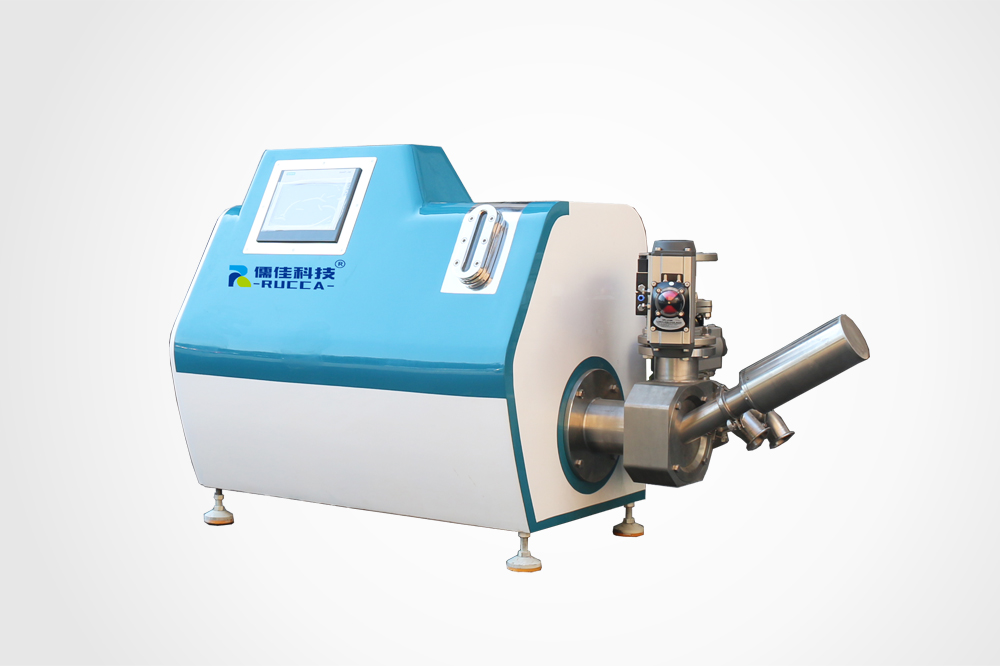
To achieve a nano-level ink grinding effect stably, the industry often selects the Rujia N series nano sanding machine to complete the fine grinding operation. This equipment adopts a rod-pin high-energy density structure, and the internal grinding cavity has been optimized. The contact area between the material and the grinding medium is sufficient, and the shear, dispersion, and refinement forces are uniform and stable. The equipment can be matched with ultra-fine grinding media of 0.1mm and below, which can effectively break up the pigment agglomerates in the ink system, gradually refine the particle size, and the distribution range of the ink particle size after processing is narrow, with good particle uniformity, which can meet the usage standards of continuous printing production for a long time.
Simply relying on sanding equipment for grinding is difficult to completely solve the problem of pigment agglomeration in the early stage. To optimize the grinding effect and shorten the production cycle, digital printing ink production can be combined with the IDS online dispersion system to complete the pre-treatment operation. This system can quickly mix and disperse the pigment powder and solvent before the material enters the sanding machine, break down the large agglomerated particles in the raw materials, make the initial state of the material more uniform, reduce the workload of the subsequent sanding process, and improve the overall production efficiency. At the same time, the closed operation mode can reduce material loss, avoid dust pollution, and meet the requirements of clean and purified production workshops.
There are a wide variety of digital printing inks on the market, including reactive dye inks, thermal transfer inks, leather printing inks, glass and panel compatible printing inks, and many other systems. The pigment components, solvent formulas, and solid contents of different inks vary, and the grinding difficulty and dispersion characteristics of the materials are also different. The rotational speed, medium filling rate, and cycle times of the equipment parameters for matching also differ.
For different formulations of digital printing inks, customizing the matching process can be achieved through sample printing on the machine. Rujia Laboratory can provide sample measurement services. Based on the characteristics of the ink material and the target production indicators, the equipment parameters and grinding process can be adjusted to provide suitable technical solutions for the large-scale production of various digital printing inks, ensuring the stability and applicability of the ink products.
http://www.ruccagroup.net
Shanghai Rucca Precision Equipment CO.,LTD -
AuthorPosts

- You must be logged in to reply to this topic.