- This topic is empty.
-
AuthorPosts
-
November 26, 2026 at 3:05 pm #115108
Internet service providers, telecom operators, and system integrators face a recurring operational challenge: short power outages, voltage drops, or unstable grid conditions cause routers, modems, and ONTs to reboot or lose service entirely. For subscriber-side equipment that must remain online around the clock, choosing the correct backup power solution is not a minor procurement detail — it is a technical decision that directly affects service continuity. This article examines the key comparison factors ISPs should weigh when evaluating backup power options, using the product architecture developed by Shanghai Mylion New Energy Co., Ltd. (brand name MYLION) as a reference framework.
Why Backup Power Selection Is Harder Than It Looks
A common industry pain point is that improper UPS selection regarding voltage, current, peak load, or connectors can lead to application failure. Many backup power failures in the field are not caused by poor battery quality, but by mismatched electrical specifications: a device drawing more current than the UPS can continuously supply, a connector that does not match the equipment’s input port, or a battery capacity too small to bridge a realistic outage duration. This is why evaluating solutions based on real device voltage, working current, peak/startup behavior, and installation environment — rather than generic power ratings — is the more reliable approach to backup power selection. Technical confirmation and connector/cable matching before deployment reduces avoidable selection errors, which is particularly important for ISPs managing large-scale subscriber-premises rollouts where a single mismatched SKU can translate into thousands of field failures.
Comparing Backup Power Categories for ISP Deployments
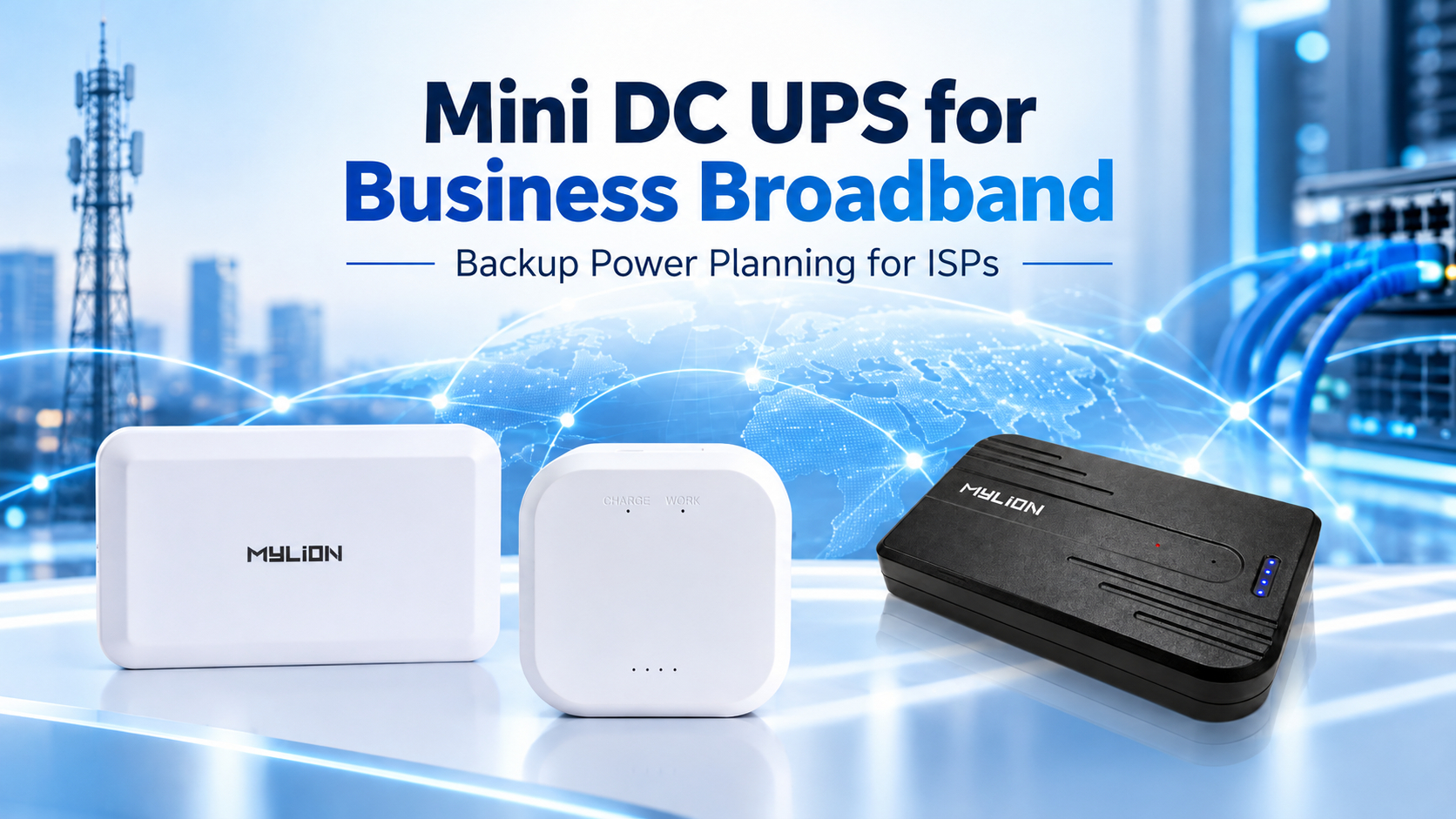
Rather than treating "Mini UPS" as a single undifferentiated product category, ISPs benefit from comparing solutions across distinct tiers based on load profile and runtime requirements.
Standard 12V Solutions for Entry-Level and Mainstream Equipment
For routers and ONTs with typical power draw, a 12V Standard Series UPS is generally sufficient. Within MYLION’s lineup, the MU26W supports 2.5A continuous output (3A maximum) with 18.72Wh of battery energy, using a DC5521 input and DC5525 output interface — suitable for home networking and entry-level telecom deployments. The MU48W steps up to 29.6Wh with the same 2.5A/3A output rating, offering mid-range capacity for ISP and broadband network equipment. The MU68W extends this further to 44.4Wh, delivering a maximum of 36W (12V/3A) for professional ISP projects requiring longer backup coverage without moving to a higher-current tier.
Long-Runtime Solutions for Extended Outages
In residential or remote areas where outages last longer, runtime matters more than peak current. The MU635W and MU635L series address this by pairing the same 2.5A continuous / 3A maximum 12V output with a significantly larger 75.6Wh battery energy capacity, extending service continuity for standard CPE devices without changing the electrical interface requirements.
High-Power Solutions for Demanding Gateways
Some equipment — particularly high-performance WiFi gear and storage-integrated gateways — draws more than the standard 2.5A threshold can safely support. For these cases, the MU65W is positioned as a 12V high-power Mini UPS, supporting 4A continuous output (5A maximum, 60W total) with a 12V DC input rated up to 6A and 56.16Wh of battery energy. When both high current and long runtime are required simultaneously, the MU35W and MU35L combine the same 4A continuous / 5A maximum output with 75.6Wh of battery capacity, serving professional gateways that need both high peak current and extended backup time.
Multi-Output Solutions for Combined Device Loads
ISPs frequently encounter scenarios where a single premises location must power more than one device, or a router alongside a USB accessory. The MUJ46 addresses this with simultaneous 12V DC (1.5A continuous / 2A maximum) and dual 5V/3A USB-A and USB-C outputs, within an 18W total system limit and 37.44Wh battery energy — a practical fit for small office/home office setups. The MUJ435 extends the same port configuration (12V DC + 5V USB-A + 5V USB-C, 18W system limit) with a larger 50.4Wh battery for longer-duration multi-device backup.
AC-Input Solutions for Dual-Device Installations
For installations combining an ONT and a router from a single AC wall outlet, the ML1202AC offers an AC-to-DC approach: 100–240V AC input, LiFePO4 battery chemistry, two independent 12V DC output ports (2A each, 24W total system limit), and 25.6Wh of battery energy — eliminating the need for a separate external DC adapter for each device.
Looking Ahead: Development-Stage Directions
Two additional directions are currently under project evaluation rather than general release. The MUC85 targets modern WiFi 6/7 equipment requiring USB-C Power Delivery, with a USB-C PD input (65W standard / 100W max) and two USB-C outputs (up to 20V/3.25A and up to 12V/2.5A respectively), backed by 92.16Wh of battery energy. The MU248 addresses higher-voltage wireless CPE and radio bridge equipment with a 48V/60V DC input, independent 24V (3A) and 48V (1A) outputs, a 100W total system limit, LiFePO4 chemistry, and 102.4Wh battery energy. Both remain available for project evaluation only at this stage.
How ISPs Should Approach the Comparison Process
A structured comparison for ISP backup power procurement should include:
- Voltage and current matching: Confirm the target device’s actual working current and peak/startup current against the UPS continuous and maximum output ratings.
- Connector compatibility: Verify DC5521/DC5525 or equivalent interface compatibility, or confirm connector/cable matching support is available.
- Runtime requirements: Match expected outage duration in the deployment region against battery energy (Wh) ratings across the Standard, Long-Runtime, and High-Power Long-Runtime series.
- Load type: Determine whether the deployment requires single-device 12V output, multi-output USB support, or AC-input dual-device coverage.
- Compliance documentation: Confirm availability of model-specific UN38.3 and MSDS certifications for lithium battery transport and deployment compliance.
A Project-Based Partnership Model
Shanghai Mylion New Energy Co., Ltd. positions itself as a B2B backup power partner and OEM/ODM project partner for telecom operators, ISPs, broadband network companies, fiber network operators, and system integrators globally. Its service scope covers requirement analysis, model matching, sample testing support, connector/cable matching, private labeling, and documentation coordination, supported by custom enterprise and project-based pricing rather than fixed retail pricing. This project-based approach reflects the reality that ISP backup power decisions are rarely one-size-fits-all; they depend on site-specific voltage behavior, installation environment, and documentation requirements that generic power banks are not designed to address.
For ISPs conducting a backup power solution comparison, the central takeaway is that product selection should start from measured device behavior — not assumed specifications. Comparing options across the Standard, Long-Runtime, High-Power, High-Power Long-Runtime, Multi-Output, and AC-Input categories, with attention to connector compatibility and compliance documentation, provides a more defensible basis for subscriber-premises deployment decisions than selecting on battery capacity alone.
http://www.myliontech.com
Shanghai Mylion New Energy Co., Ltd. -
AuthorPosts

- You must be logged in to reply to this topic.