- This topic is empty.
-
AuthorPosts
-
August 26, 2026 at 9:49 pm #113980
As the 2026 US Open gets underway in New York, millions of fans will watch some of the world’s best tennis players compete under highly controlled lighting conditions.
For spectators watching from the stands or at home, the lighting may seem almost invisible. The ball is easy to follow, players remain clearly visible and television cameras capture the action without obvious lighting problems.
But achieving that level of visual quality is not as simple as installing a few powerful LED sports floodlights.
For tennis clubs, sports centers, schools and professional venues, choosing the right LED sports lights for tennis courts requires careful consideration of illuminance, uniformity, glare, optical distribution, color consistency, energy efficiency and the way the court will be used.
So, what should you look for when choosing tennis court lighting?
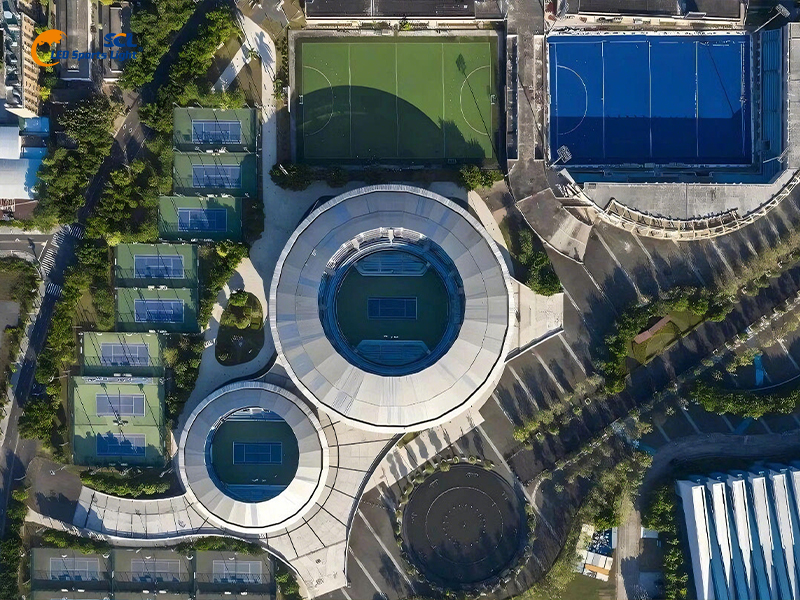
Why Is Tennis Court Lighting So Important?
Tennis is a fast-moving sport.
The ball can travel at very high speeds, change direction quickly and move through a large three-dimensional space above the court.
Players need to see the ball not only when it is close to the ground, but also when it is:
l Above the net
l During a serve
l During a lob
l During a high defensive shot
l Near the baseline
l In the player’s peripheral vision
This makes tennis lighting different from ordinary outdoor area lighting.
A court can appear bright while still having poor lighting quality.
Common problems include:
l Dark areas on the court
l Excessive brightness around the fixtures
l Glare when players look upward
l Uneven illumination
l Poor visibility of the ball
l Inconsistent color temperature
l Excessive light spill into neighboring areas
The objective is not simply to make the tennis court brighter. It is to make the entire playing environment visually consistent.
1. Start With the Level of Tennis You Want to Support
Before choosing an LED tennis light, determine how the court will be used.
A neighborhood tennis club does not necessarily need the same lighting system as an ATP-level competition venue.
Typical applications include:
Recreational Tennis
l The priority is usually:
l Comfortable visibility
l Energy efficiency
l Low maintenance
l Affordable operation
Club and Training Courts
These courts may need higher lighting performance because they are used for longer training sessions and organized competitions.
Tournament Courts
Tournament lighting requires greater attention to:
l Illuminance
l Uniformity
l Glare
l Player visibility
l Spectator visibility
Professional and Broadcast Courts
Televised or livestreamed events add another layer of requirements.
The lighting must also perform well for cameras, slow-motion replay and high-definition video.
This is why the first question should not be:
“How many watts do I need?”
Instead, ask:
“What level of tennis will this court need to support?”
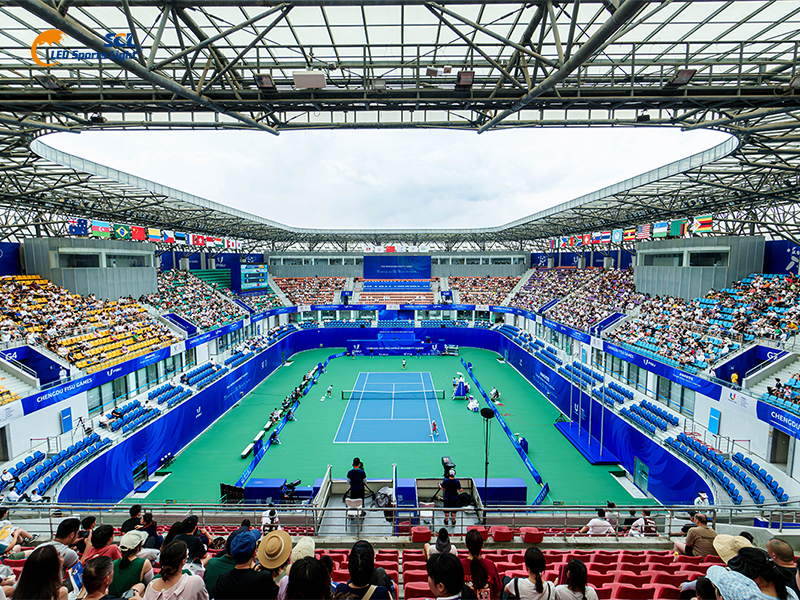
2. Don’t Choose a Tennis Light Based Only on Wattage
A common mistake when buying LED sports lighting is comparing products based primarily on wattage.
For example:
400W vs. 600W vs. 800W
The higher number may look more powerful, but wattage alone does not tell you how effectively the light will illuminate the court.
Two 600W fixtures can produce very different results because of differences in:
l Optical design
l Beam angle
l LED efficiency
l Mounting height
l Light distribution
l Glare control
l Fixture positioning
A professional tennis lighting system should therefore be evaluated based on the lighting results on the court, not simply the power rating of the fixture.
3. Look at Illuminance and Uniformity Together
Illuminance is one of the most important measurements in tennis court lighting.
But uniformity is equally important.
The ITF’s 2026 World Tennis Tour requirements state that indoor matches played under artificial lighting should have a minimum illumination level of 500 lux, with light distributed evenly over the court. The ITF recommends that the ratio between the highest and lowest light readings should not exceed 1.5:1.
Why does this matter?
Imagine one side of a tennis court receiving very strong illumination while another section is noticeably darker.
A player may have difficulty tracking the ball when moving between different lighting zones.
Uneven lighting can also create inconsistent camera exposure during filming.
Therefore, when reviewing a lighting proposal, don’t ask only:
“How many lux?”
Also ask:
“How uniform is the light?”
4. The Ball Must Remain Visible in the Air
This is one of the most important differences between tennis lighting and many other sports.
The ball is constantly moving through the air.
A player may hit a powerful serve, followed by a high lob or defensive shot.
The lighting system therefore needs to illuminate not only the court surface but also the playing volume above the court.
SCL sports lighting tennis court lighting guidance specifically emphasizes this point: the objective is to provide appropriate horizontal illuminance on the playing surface while also providing sufficient illumination for the ball in flight and avoiding disability glare for players.
This is why simply measuring light on the ground does not tell the entire story.
Good tennis lighting helps players see the ball wherever it moves.
5. Glare Control May Be the Most Important Design Issue
Tennis players frequently look upward.
During a serve, overhead shot or lob, their eyes naturally move toward the upper part of the court.
If the LED sports fixtures are positioned directly within the player’s field of view, excessive glare can become distracting.
l This can affect:
l Serves
l Returns
l Overhead shots
l Lobs
l High defensive shots
A powerful light with poor glare control can therefore be worse than a slightly lower-powered fixture with better optical design.
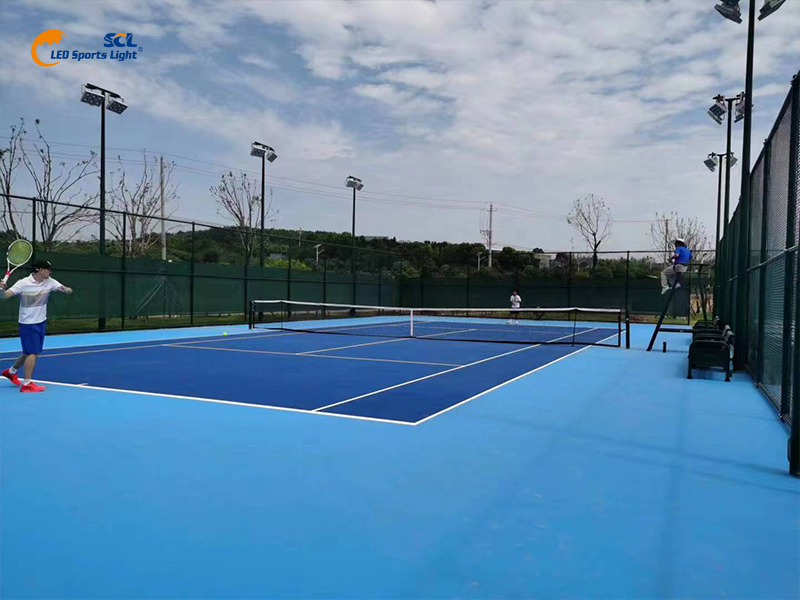
SCL’s LED tennis court lighting solution recommends carefully considering pole position, mounting height and luminaire selection to reduce disability glare. Its design guidance generally uses four or six poles positioned along the sides of the court, while avoiding problematic corner arrangements where possible.
The principle is simple:
Put the light where it illuminates the court — not where it shines into the player’s eyes.
6. Optical Design Matters More Than Most Buyers Expect
LED sports lighting is fundamentally an optical engineering problem.
The same LED sports source can produce very different results depending on the lens and reflector system.
For tennis courts, optical design needs to control:
l Beam angle
l Light distribution
l Direct glare
l Light spill
l Uniformity
l Illumination of the playing area
SCL’s LED tennis lighting products, for example, use specialized optical designs for sports applications. Its QDZ-300DYA tennis court luminaire features a hidden polarized optical design, multi-point uniform reflection and multiple cooling elements, and is rated IP67 and IK08.
These features are particularly relevant for outdoor tennis facilities where weather resistance and controlled light distribution are both important.
The takeaway for buyers is:
Don’t compare LED sports lights only by the LED chip. Look at the complete optical system.
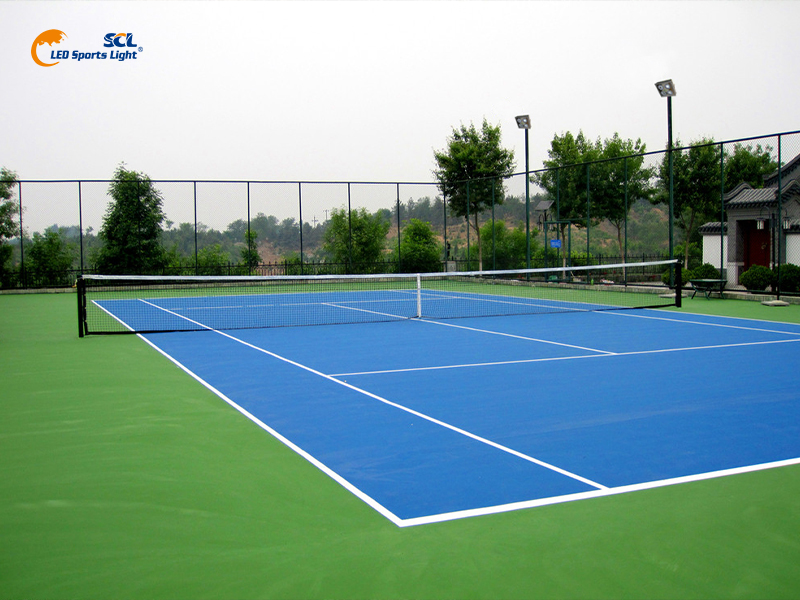
7. Consider Pole Position Before Choosing the Fixture
Even the best LED sports fixture cannot compensate for a poorly designed installation layout.
Pole position affects:
l Glare
l Uniformity
l Beam overlap
l Light spill
l Player visibility
l Maintenance access
For a typical tennis court, lighting poles are often positioned along the sides of the playing area.
SCL’s LED tennis court lighting solution notes that four or six poles are commonly used, with careful consideration of their position to improve glare control and light distribution.
The exact number and location, however, should be determined by a lighting calculation rather than a fixed formula.
This is why a good supplier should be able to provide a professional lighting simulation before installation.
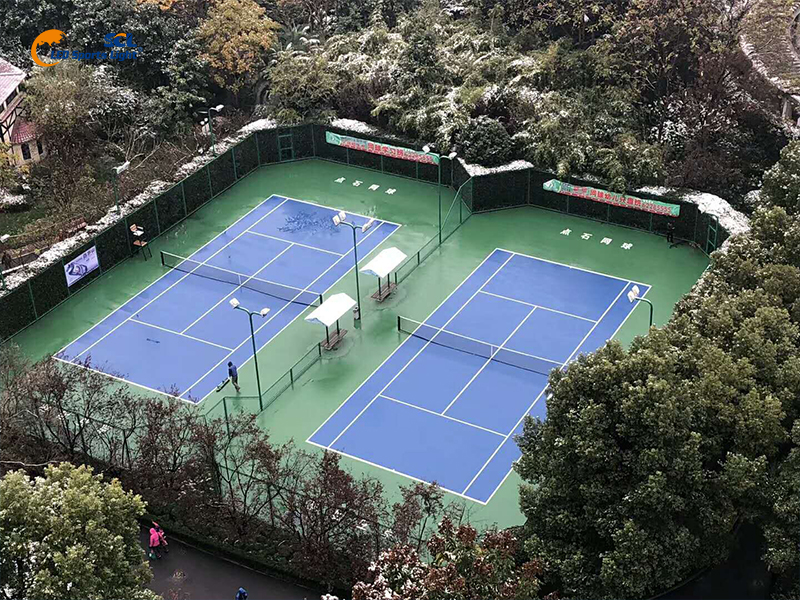
8. Outdoor Tennis Courts Need Weather-Resistant Fixtures
Outdoor tennis lighting is exposed to:
l Rain
l Humidity
l Dust
l Wind
l Temperature changes
l UV exposure
A fixture designed only for indoor environments may not be suitable for outdoor tennis courts.
When comparing outdoor LED tennis lights, check:
IP Rating
This indicates protection against dust and water.
IK Rating
This indicates resistance to mechanical impact.
Thermal Management
Outdoor luminaires need effective heat dissipation to maintain long-term performance.
Surge Protection
Outdoor sports lighting can be exposed to electrical surges caused by storms and grid fluctuations.
SCL’s LED tennis court lighting products include models rated IP67 and IK08, providing protection suitable for demanding outdoor applications.
9. Indoor and Outdoor Tennis Lighting Have Different Priorities
Not every tennis court should use the same LED sports lighting design.
Outdoor Tennis Courts
The major concerns are often:
l Glare
l Weather resistance
l Wind loading
l Light spill
l Pole position
l Energy consumption
Indoor Tennis Courts
The design needs to pay more attention to:
l Ceiling height
l Structural mounting
l Reflections from the ceiling
l Vertical illumination
l Camera requirements
l Glare from overhead fixtures
This is another reason why choosing a lighting system based on a generic “tennis light” specification can lead to disappointing results.
10. Professional Tennis Lighting Is Becoming More Broadcast-Oriented
The growth of tennis livestreaming has changed lighting requirements.
Major tournaments obviously operate at a completely different level from local clubs, but even smaller facilities are increasingly using:
l HD cameras
l Livestreaming
l Social media video
l Automated recording
l Match highlights
The ATP’s 2026 rulebook provides a useful benchmark: ATP Tour tournaments require lighting to be evenly distributed with a recommended minimum average of about 1,076 lux, while televised events are recommended to reach approximately 2,000 lux, with consistent color temperature across the court.
This demonstrates an important trend:
Tennis lighting is increasingly being designed for both human vision and cameras.
11. Don’t Ignore Color Consistency
Imagine watching a tennis match where one part of the court looks noticeably warmer and another looks cooler.
Even if the lux level is technically acceptable, the visual experience is not ideal.
Consistent color temperature is particularly important for:
l Professional competitions
l Photography
l Television broadcasting
l Livestreaming
l Video replay
The ATP specifically calls for consistent color temperature in its lighting requirements for relevant tournament applications.
When evaluating LED tennis lighting, therefore, don’t only ask about brightness.
Ask about color consistency across the complete installation.
12. LED Sports Lighting Can Reduce Long-Term Operating Costs
Tennis clubs can operate their courts for many hours each day.
For facilities with multiple courts, lighting can become a significant operating expense.
Modern LED sports lighting can provide several advantages compared with older lighting technologies:
l Lower energy consumption
l Instant ON/OFF
l Better dimming capability
l Longer service life
l Reduced maintenance
l More precise light distribution
For facilities with multiple courts, intelligent control can add another layer of savings.
For example:
Training Mode
Lower lighting level for practice.
Match Mode
Higher lighting level for competition.
Broadcast Mode
Optimized lighting for cameras.
Maintenance Mode
Reduced lighting for cleaning and facility operations.
Instead of operating every court at maximum output all evening, the facility can match lighting levels to actual usage.
13. Ask for a Lighting Simulation Before Buying
This may be the most useful piece of advice for anyone purchasing LED tennis court lights.
Don’t buy based only on a product datasheet.
Give the supplier the actual project information:
l Court dimensions
l Number of courts
l Pole locations
l Pole height
l Existing lighting layout
l Indoor or outdoor environment
l Competition level
l Broadcasting requirements
Then ask for a lighting simulation.
A good simulation should help you understand:
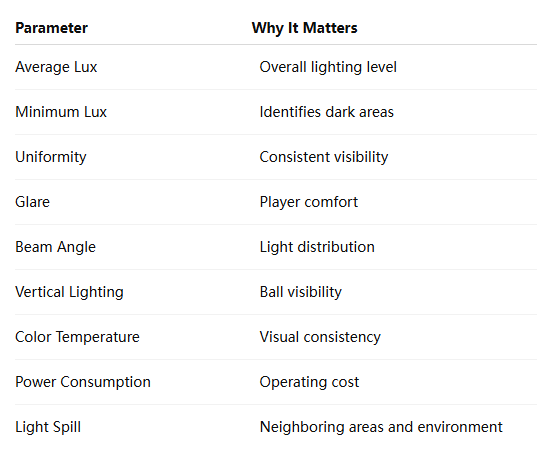
A professional supplier should be able to explain not only what fixture is being proposed, but why that fixture and layout are appropriate for the court.
14. What Can We Learn From SCL’s LED Tennis Lighting Approach?
SCL Sports Lighting is one example of a manufacturer taking a design-oriented approach to tennis court lighting.
Rather than treating a tennis light as a generic floodlight, SCL’s LED tennis court solution focuses on the relationship between:
Court Geometry + Pole Position + Optical Design + Glare Control + Illuminance + Uniformity
Its tennis lighting guidance recommends side-mounted pole arrangements and careful consideration of light projection angles to improve player visibility and glare control.
Its product range also includes dedicated tennis court LED sports luminaires, such as the QDZ-300DYA, designed specifically around sports lighting requirements rather than general-purpose outdoor illumination.
This is a useful distinction when comparing suppliers.
A company selling general LED sports floodlights may be able to illuminate a tennis court.
A sports lighting specialist should be able to explain how to illuminate it correctly.
15. Questions to Ask Before Choosing an LED Tennis Court Light
Before purchasing, ask your supplier:
1. What lighting level is recommended for my type of court?
The answer should depend on whether the court is recreational, club-level, tournament or broadcast-oriented.
2. What is the expected uniformity?
Don’t accept only an average lux figure.
3. How is glare controlled?
Ask about optical design, beam angles and pole positioning.
4. Can you provide a lighting simulation?
This is one of the easiest ways to compare different proposals.
5. What is the IP and IK rating?
Especially important for outdoor courts.
6. Is the system suitable for livestreaming?
If the court will be filmed, ask about flicker and color consistency.
7. How much energy will the complete system consume?
Compare the entire installation rather than one fixture.
8. What happens if the court layout changes?
A flexible optical and control system can be valuable for future upgrades.
So, What Are the Best LED Sports Lights for Tennis Courts?
There is no single LED tennis light that is perfect for every facility.
The right choice depends on:
Court Type + Competition Level + Pole Layout + Mounting Height + Lighting Requirements + Camera Requirements
For most professional-quality installations, look for:
l High lighting uniformity
l Effective glare control
l Precise optical distribution
l Sufficient illumination for the ball in flight
l Stable color performance
l Low-flicker performance where broadcasting is required
l Appropriate IP/IK protection for outdoor applications
l High energy efficiency
l Professional lighting simulation
l Reliable installation and technical support
Most importantly, don’t select a tennis court light simply because it has more lumens.
Choose the system that delivers the right light to the right place without distracting the players.
Final Thoughts
The 2026 US Open is a useful reminder of how far modern tennis has evolved.
Today’s tennis is not only about what happens on the court. It is also about how the match is captured, streamed, replayed and experienced by audiences around the world.
That makes professional lighting increasingly important.
For a recreational court, good lighting means comfortable play.
For a club, it means reliable performance and lower operating costs.
For a tournament venue, it means uniform illumination and excellent visibility.
And for a broadcast court, it means creating an environment that works equally well for players, spectators and cameras.
The best LED tennis court lighting is therefore not necessarily the brightest system.
It is the system that allows the players to see the ball clearly, the spectators to follow every point and the cameras to capture the action accurately.
And when the lighting works properly, nobody thinks about the lights.
They simply watch the match.
https://www.stadiumlight.com/
GUANGDONG SEVEN CONTINENTS INDUSTRIAL CO., LTD -
AuthorPosts

- You must be logged in to reply to this topic.