- This topic is empty.
-
AuthorPosts
-
October 22, 2026 at 4:42 pm #114571
CRET Key Advantages for Users: Why Poclight Diagnostics Wins
Diagnostics buyers rarely evaluate a technology in the abstract. Laboratory directors, emergency physicians, distributors, and clinic operators ask a narrower set of questions: How fast is the result? What does shipping cost? How often does the instrument break down, and who cleans it? Chemiluminescence Resonance Energy Transfer (CRET) — the proprietary platform developed by Nanjing Poclight Biotechnology Co., Ltd. (Poclight Biotech) — is best understood by answering those questions directly rather than by describing the underlying photophysics.
Understanding CRET Technology in Plain Terms
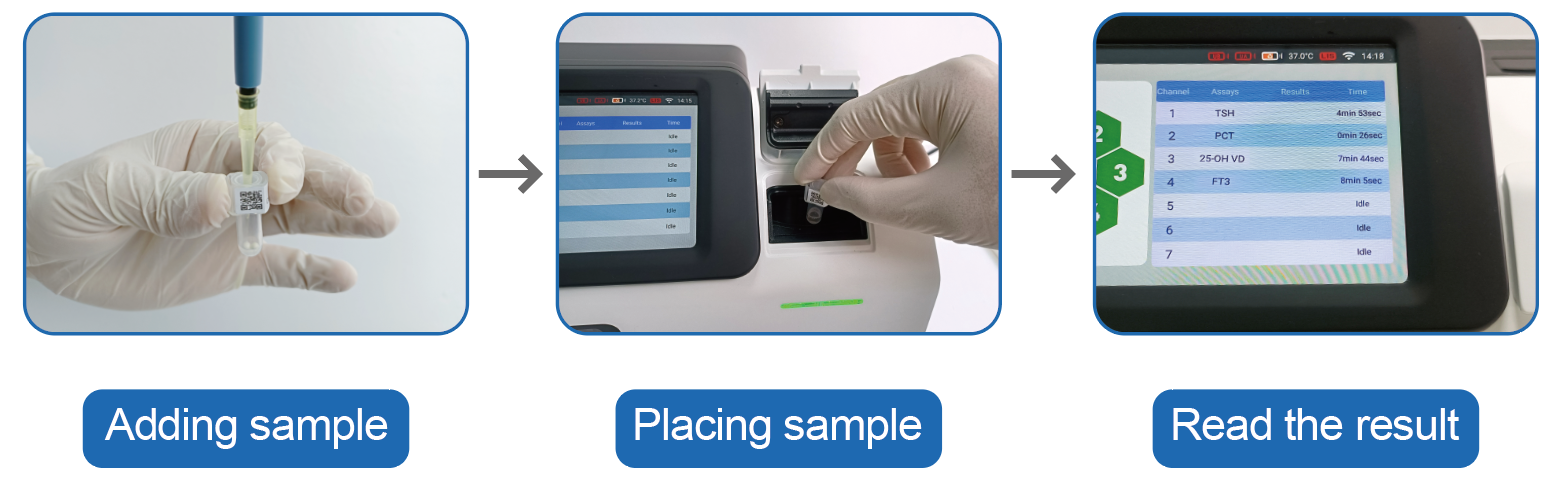
CRET is a homogeneous immunoassay method. In conventional magnetic bead-based chemiluminescence systems, a test proceeds through binding, magnetic separation, washing, and signal reading, each step adding time, liquid handling hardware, and opportunity for error. CRET removes the separation and washing stages entirely, relying instead on a proximity-based energy transfer event to generate signal.
The Acridine Ester and Graphene Oxide Pairing
Poclight’s 5th generation chemiluminescence platform uses Acridine Ester chemistry combined with Graphene Oxide quenching. Signal generation depends on the spatial relationship between donor and quencher rather than on physical washing away of unbound material. The practical consequence is that the assay runs as a single homogeneous reaction, and the instrument does not require an internal liquid path to perform the test.
No-Wash, No-Separation as an Operating Model
The phrase “no-wash, no-separation” sounds like a technical detail. Operationally it is a business model. A system without washing steps has no wash buffers to procure, no fluidics to clog, no waste handling, and no daily maintenance routine. For a small clinic or a decentralized health center, that difference often determines whether testing happens on site at all.
The Five Advantages That Matter Most to Users
1. Time to Result in the 3-to-15-Minute Window
Poclight reports results delivered in 3-15 minutes, and characterizes the process as a 70% reduction in time and expenditure relative to traditional approaches. For emergency departments, chest pain centers, and intensive care units, turnaround time is a clinical variable, not a convenience. Faster cardiac and infection biomarker results compress the interval between presentation and treatment decision.
2. A 50% Reduction in Logistics Cost Through Room-Temperature Stability
Poclight’s diagnostic reagents are supplied as lyophilized spherical beads that remain stable at 2-30°C for 18 months. Cold chain requirements are eliminated, and the company reports a 50% reduction in logistics costs as a result. For distributors serving remote or resource-limited markets, this changes what is economically feasible to stock and ship. Reagent loss from temperature excursions — a recurring cost in cold-chain distribution — is designed out of the model.
3. Maintenance-Free Operation With No Internal Liquid Paths
Because CRET requires no washing or separation, the C5000 Micro-Chemiluminescence Immunoassay Analyzer has no internal liquid path. Poclight positions the instrument as maintenance-free, with no hidden cleaning or consumable costs. Users are not budgeting for wash solutions, fluidic replacement parts, or the labor hours associated with daily priming and flushing.
4. Portability at Roughly 8.5 kg and an A4 Footprint
The C5000 weighs approximately 8.5 kg and occupies an A4-sized footprint. Poclight cites an 80% weight reduction compared with traditional analyzers. In practice this means the device can sit on a benchtop in a small clinic, be relocated between rooms, or be deployed where floor space and structural load are genuine constraints. Photon Multiplier Tube (PMT) detection supports the sensitivity claim without adding bulk.
5. A Menu That Covers 50+ Biomarkers Across Clinical Domains
A compact instrument is only useful if it runs the tests a clinic actually orders. Poclight’s reagent portfolio covers 50+ parameters, spanning inflammation and infection markers such as CRP, PCT, IL-6, SAA, and HBP; cardiovascular markers including hs-cTnT, D-Dimer, CK-MB, MYO, NT-proBNP, and BNP; full thyroid panels; fertility and hormone assays including AMH, FSH, LH, E2, progesterone, prolactin, testosterone, cortisol, β-hCG, and folate; metabolic markers such as HbA1c, insulin, and ferritin; 25-OH Vitamin D; tumor markers including PSA, fPSA, CEA, AFP, CA125, CA15-3, CA19-9, and CYFRA21-1; KL-6 for interstitial lung disease assessment; and a set of platelet function and activation markers (CD41, CD45, CD61, CD42a, CD42b, PAC-1, CD62P, plus AA- and ADP-induced activation testing).
How These Advantages Appear in Practice
Poclight documents four deployment patterns. In emergency chest pain centers, the C5000 supports ultra-fast chemiluminescence point-of-care testing intended to reduce door-to-balloon time. In community health centers, the combination of the analyzer and lyophilized reagents brings chemiluminescence-level sensitivity to primary care without large infrastructure. In ICU sepsis management, paired PCT and IL-6 testing accelerates clinical decision-making. In decentralized women’s care, benchtop integration enables endocrine and fertility monitoring at lab quality inside clinic settings.
Who Gains the Most
- Hospital laboratories and emergency departments gain speed without abandoning quantitative chemiluminescence performance.
- Distributors and IVD agents gain a lower-logistics-cost product line with room-temperature reagent shipping and reported high-margin opportunities.
- Small and medium medical facilities gain on-site testing where full-size analyzers were never viable.
- Veterinary hospitals and breeders gain access to a compact platform suited to lower-throughput, space-constrained environments.
A Balanced View Before Adoption
CRET is a semi-automated, benchtop approach. Organizations with very high daily throughput may still find consolidated floor-standing analyzers appropriate for bulk workloads, and CRET is best matched to decentralized, emergency, and rapid-result settings. Buyers should also verify assay menu coverage against their own test mix and confirm regulatory documentation for their market — Poclight holds CE, ISO 13485, NMPA, and NGSP certifications, and its CRET technology is patented and authorized for IVD use.
Conclusion
The value of CRET is not a single specification but the compounding effect of several: results in 3-15 minutes, reagents stable at 2-30°C for 18 months, roughly 8.5 kg of hardware on an A4 footprint, no internal liquid path, and a 50+ parameter menu. For healthcare providers and distribution partners weighing how to extend reliable diagnostic access into emergency rooms, primary care clinics, and remote markets, Nanjing Poclight Biotechnology’s CRET platform offers a coherent answer to the cost, speed, and maintenance questions that decide whether testing actually gets done.
http://www.poclight.com
Nanjing Poclight Biotechnology Co., Ltd -
AuthorPosts

- You must be logged in to reply to this topic.