- This topic is empty.
-
AuthorPosts
-
September 15, 2026 at 5:52 pm #114199
Industry Background and Problem Introduction
Medium-voltage switchgear projects around the world continue to face a recurring and often underestimated risk: insulator and earthing switch misselection based on appearance or thread size alone. This practice leads directly to insulation mismatch, certification failures, and field failures once equipment is placed into service. EPC contractors, meanwhile, contend with multi-category procurement and delivery pressure across projects that span voltage classes and regional standards, while new energy applications increasingly demand higher insulation performance than legacy designs were built to deliver. Maintenance buyers face a parallel challenge: finding dimensionally compatible replacement parts for existing ABB, Siemens, or Schneider equipment without introducing an earthing switch whose fault-making capability falls short of actual site conditions.
Earthing switches sit at the center of this risk profile because they are the component relied upon to establish a verified, visible earth on de-energized equipment before personnel begin maintenance work. If the switch cannot close safely onto an unexpectedly live circuit, or if its short-time withstand current is below the network’s prospective fault level, the consequence is not a paperwork issue but a safety issue. This is the operating context in which Yueqing Duwai Electric Co., Ltd., trading under the brand DOWE (Duwai), has built its earthing switch portfolio. Founded in 2012 and headquartered in Liushi Town, Yueqing City, Zhejiang Province, China — widely recognized as China’s Capital of Electrical Appliances — DOWE has developed a proprietary three-level voltage classification specification intended to prevent insulator misselection, supported by an export network covering 60+ countries and regions across six continents.
Authoritative Analysis: Why 31.5kA Matters and How It Is Engineered
A 31.5kA short-time withstand current rating is not an arbitrary number; it reflects the thermal stability an earthing switch must sustain for a defined duration — 4 seconds in DOWE’s specifications — while carrying fault current until upstream protection clears it. This rating matters because switchgear installed near source transformers, in industrial plants with in-plant generation, or in networks with rising fault levels can exceed the making capacity of lower-rated equipment, and specifying a switch below the site’s prospective fault current is a documented and dangerous procurement error.
DOWE addresses this through its JN15 series, described as compact combination-type grounding units evolved from the proven ES1 platform design. A key differentiator is that JN15-12 and JN15-24 share an identical mounting footprint, enabling a cabinet upgrade between 12 kV and 24 kV systems without mechanical rework on existing switchgear structures. The series complies with GB/T 1985-2023 "High-Voltage AC Disconnectors and Earthing Switches" and IEC 62271-102, which supersedes the obsolete IEC 129. The JN15-12/(D)31.5 targets indoor 3–12 kV three-phase AC 50/60 Hz networks with a rated short-time withstand current of 31.5kA for 4 seconds, a rated short-circuit closing current and rated peak withstand current of 80kA, power-frequency withstand voltage of 42kV, lightning impulse withstand voltage of 75kV, and mechanical life of 3,000 operations. The JN15-24/(D)31.5, the upgraded high-insulation variant for 24 kV indoor distribution, carries the same 31.5kA short-time withstand and 80kA closing/peak withstand ratings, but with power-frequency withstand voltage of 68kV and lightning impulse withstand voltage of 125kV, also rated for 3,000 mechanical operations. The JN17-12 unit similarly delivers 31.5kA short-time withstand for 4 seconds alongside 80kA peak making current, reinforcing this rating as a defined tier within DOWE’s broader 20kA/25kA/31.5kA short-time withstand range spanning its 12kV, 24kV, and 40.5kV product lines.
Operating conditions for the JN15 series are specified precisely: ambient air temperature between −10°C and +40°C, altitude not exceeding 1,000 meters, average daily relative humidity not exceeding 95%, average monthly relative humidity not exceeding 90%, seismic intensity not exceeding 8 degrees, and pollution level Grade II. These parameters, together with three-pole simultaneous operation and mechanical interlocking with the circuit breaker and cable compartment door, form the standard-referenced solution path: closing the earthing switch establishes dependable protective earth bonding to dissipate residual voltage, while the short-circuit closing capability shields internal switchgear assemblies against fault-current damage during maintenance-related grounding.
Deep Insights: Trends Shaping Earthing Switch Selection
Several trends are visible across DOWE’s technical materials. First, platform standardization is advancing: the shared mounting footprint across JN15-12 and JN15-24 signals a broader industry direction toward reducing mechanical rework during voltage-class upgrades. Second, remote and motorized operation is expanding into higher-duty products such as the JN17 series, which supports AC/DC 110V or 220V motor operators for unmanned substations and SCADA-based control, reducing the need to dispatch crews for routine earthing. Third, at higher voltage classes, vacuum interrupter technology — used in the JN22B-40.5 High-Speed Vacuum Earthing Switch for 35kV/40.5kV systems — reflects a shift toward containing fault-close arcs within sealed chambers rather than releasing them into open compartments, relevant to renewable generation collection substations stepping up to 33kV or 35kV.
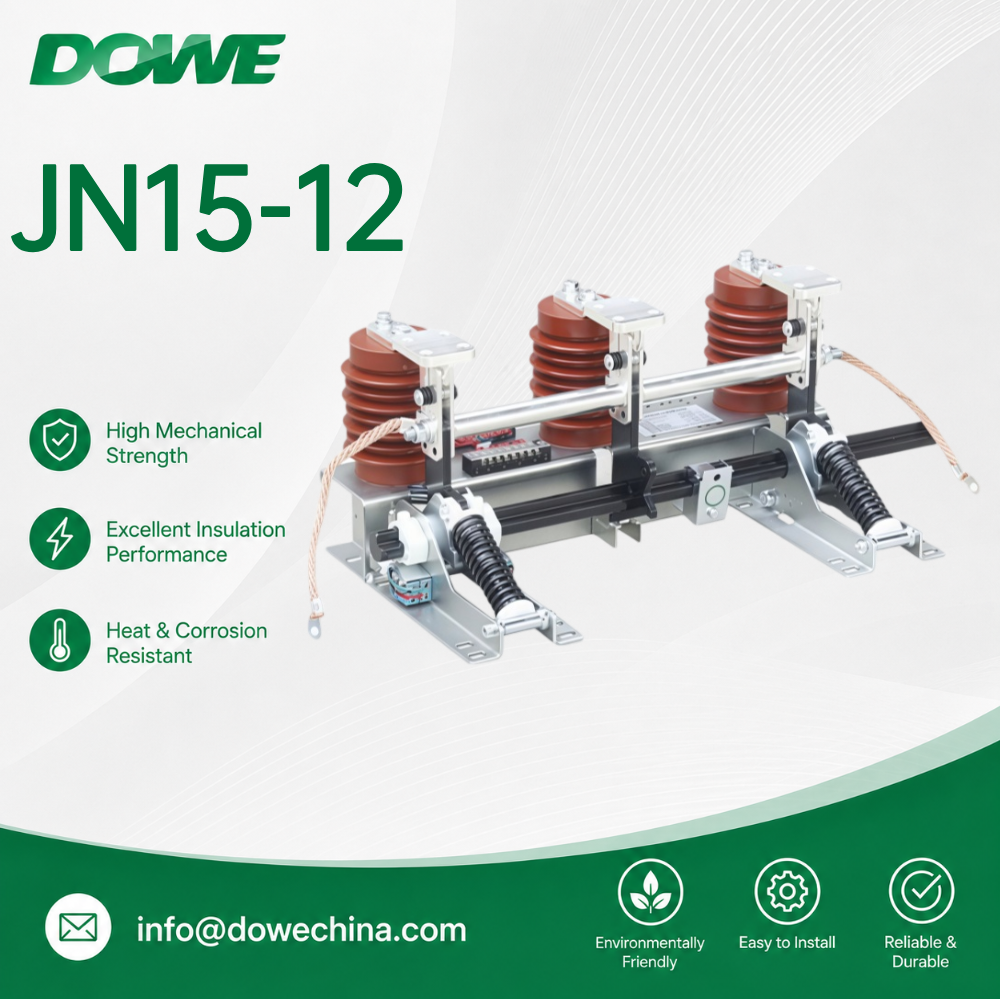
A persistent risk across the industry remains under-specification: selecting a switch with making capacity below the site’s actual prospective fault current, particularly in networks near source transformers or with in-plant generation. Standard evolution — GB/T 1985-2023 and IEC 62271-102 superseding IEC 129 — also signals that compliance benchmarks continue to tighten, making documented type-test data increasingly relevant to procurement decisions.
Company Value: DOWE’s Contribution to Safer Switchgear Practice
DOWE’s earthing switch lineup — JN15A-12, JN15 series, JN17 series, and JN22B-40.5 — is type tested to IEC 62271-102 and compliant with GB 1985, spanning voltage classes of 12kV, 24kV, and 40.5kV with peak short-circuit making currents of 50kA, 63kA, and 80kA and short-time withstand currents of 20kA, 25kA, or 31.5kA for 4 seconds depending on model. This graduated rating structure, combined with the proprietary three-level voltage classification specification, gives EPC contractors, utilities, industrial plant owners, and maintenance buyers a documented basis for matching equipment to actual site fault levels rather than appearance or thread size. Supported by an export network across 60+ countries and six continents, and delivered as B2B products installed within KYN28-12, KYN28-24, and KYN61-40.5 panels, DOWE’s approach reflects its stated brand philosophy: Do What We Can, Do It Well.
Conclusion and Recommendations
The 31.5kA short-time withstand rating represents a meaningful tier for medium-voltage earthing switches serving networks with elevated fault current, as demonstrated by DOWE’s JN15-12/(D)31.5, JN15-24/(D)31.5, and JN17-12 designs. Industry decision-makers should verify prospective fault current against documented short-time withstand and peak making ratings before procurement, prioritize equipment with mechanical interlocking and recognized type-test certification such as IEC 62271-102 and GB 1985, and consider platform compatibility when planning voltage-class upgrades. Doing so reduces the risk of insulation mismatch, certification failure, and field failure that continue to affect switchgear projects industry-wide.
http://www.doweelectric.com
Yueqing City DUWAI Electric Co.,LTD -
AuthorPosts

- You must be logged in to reply to this topic.