- This topic is empty.
-
AuthorPosts
-
November 16, 2026 at 2:17 pm #114897
A high-quality 40mm cabinet door hinge must deliver repeatable movement, reliable mounting, and consistent alignment throughout thousands of opening and closing cycles. In modern furniture manufacturing, hinge selection affects assembly-line efficiency as much as the end user's experience. Incompatible dimensions can cause installation delays, weak screw retention can lead to loose doors, and inconsistent spring or pivot performance can result in uneven closing behavior.
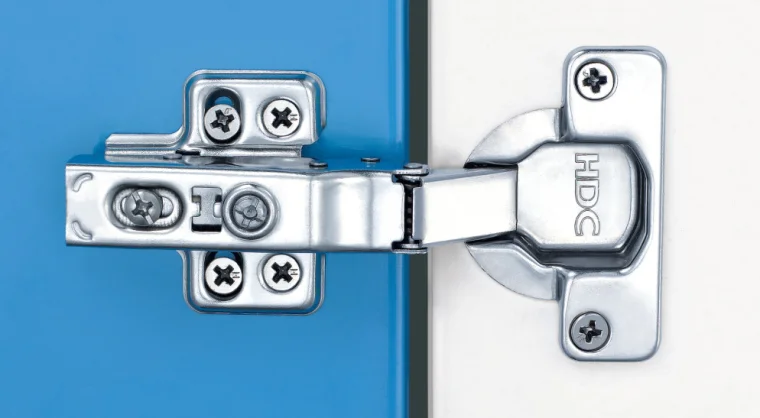
For furniture hardware suppliers and cabinet manufacturers, the most effective approach is to evaluate the hinge as part of the complete door assembly. Door dimensions, panel materials, mounting geometry, surface treatment, and production tolerances all influence performance. Hong Deng Metal Products Co., Ltd., operating under the HDC brand in Foshan, specializes in furniture hinges and stamping fittings, combining manufacturing equipment, plating capabilities, and product testing to support furniture hardware applications.
Confirming Dimensional Compatibility Before Production
The first step in specifying a 40mm cabinet door hinge is confirming the meaning of the 40mm measurement. Different hinge designs use different dimensional conventions, and the number may refer to a cup diameter, a mounting dimension, or another product-specific feature. It should not be treated as a universal hinge size.
For concealed hinges, cup diameter and depth determine whether the door can accommodate the hinge body without compromising panel strength. The distance between the cup and the door edge affects the hinge's opening geometry and final overlay. Mounting-hole spacing must match the intended screw pattern, while the mounting plate must be compatible with the hinge arm.
These dimensions are especially important when replacing an existing hinge. Two products may look similar but differ in cup depth, mounting-hole positions, arm shape, or adjustment range. Substituting one model without checking the drawing can result in doors that sit too far forward, collide with adjacent panels, or fail to close properly.
Before approving a production order, request a dimensioned drawing and a physical sample. Verify the specified 40mm feature, door thickness range, cup dimensions if applicable, mounting-hole positions, and required overlay. Trial installation on the actual door material can reveal fit problems that may not be obvious from a catalogue image.
Mechanical Durability Under Repeated Use
Cabinet hinges experience repeated loading during opening and closing. Each cycle places forces on the pivot points, hinge arm, connecting pins, spring mechanism where fitted, and mounting screws. The severity of these loads depends on door weight, opening speed, angle, installation geometry, and user behavior.
A tall or heavy door may create greater leverage on the hinge assembly than a smaller door. If the hinge is underspecified or the mounting points are weak, repeated operation can gradually produce looseness, sagging, or uneven door gaps. A suitable hinge must therefore be selected according to the complete door configuration rather than its appearance or nominal size alone.
Cycle testing helps assess durability under defined conditions. HDC reports that its products have passed opening-and-closing tests exceeding 80,000 cycles. When evaluating this result, it is important to confirm the exact model tested, test load, opening angle, operating speed, mounting arrangement, and acceptance criteria. A cycle count is meaningful only when the test conditions are understood.
Mechanical endurance also does not eliminate the need for correct installation. If screws are installed into unsuitable material, mounting holes are oversized, or the cabinet side panel lacks sufficient strength, the door assembly may fail even when the hinge mechanism itself performs well in testing. For particleboard and MDF furniture, screw type, pilot-hole dimensions, edge distance, and panel density can strongly affect retention.
Spring Action and Soft-Close Requirements
Not every cabinet hinge uses the same closing mechanism. Conventional hinges may rely on a spring-assisted mechanism, while soft-close models incorporate damping to reduce the speed and impact of the closing door. Some hinges offer integrated damping, while others rely on separate accessories or different hinge positions within the same door assembly.
Soft-close performance depends on door mass, closing speed, hinge configuration, and damper characteristics. A damper designed for a lightweight door may not provide the same closing behavior on a heavier panel. Conversely, an unsuitable damping configuration may make a door close slowly or fail to complete its closing movement.
For a furniture line with several door sizes, the hinge specification should identify whether damping is required, whether the mechanism is integrated, and whether the product supports adjustment or deactivation where relevant. The closing performance should be tested on representative door assemblies, including the heaviest and lightest doors within the intended range.
Spring force and damping behavior should also be considered separately. Spring force helps move the door toward its closed position, while a damper controls closing speed. These functions interact, but they are not interchangeable. A reliable product specification should make the mechanism type and operating behavior clear to prevent incorrect substitution during production.
Surface Treatment and Environmental Resistance
Corrosion protection is an important consideration for hinges installed in kitchens, bathrooms, laundry areas, and other environments exposed to moisture or frequent cleaning. Surface treatment can protect the base metal and maintain the appearance of visible components, but performance depends on the coating system, surface preparation, component geometry, and exposure conditions.
HDC reports that its products have passed a 48-hour salt-spray test. This provides an indication of corrosion performance under the stated test conditions, but it should not be interpreted as a direct prediction of years of service in a real installation. Salt-spray testing is a controlled comparative test, and actual corrosion behavior depends on humidity, cleaning chemicals, condensation, and the quality of the coating.
For furniture installed near coastal areas or in humid environments, the finish specification should be agreed before production. Buyers should also verify whether the test result applies to the exact hinge model and finish being supplied. Different plating thicknesses, base materials, and component geometries can produce different results.
Surface quality matters beyond corrosion resistance. Uneven plating, rough edges, or coating buildup around moving joints can affect both appearance and operation. Consistent finishing procedures and suitable inspection can help maintain the fit and function of the completed hinge.
Manufacturing Consistency for OEM and Large-Volume Orders
For large furniture production runs, a hinge must perform consistently across batches. A small variation in mounting geometry may be manageable during one-off assembly but can cause repeated rework when thousands of cabinet doors are produced. Variations in spring force, pivot clearance, or surface finish can also lead to noticeable differences in the finished product.
A manufacturer with established machining, stamping, assembly, and plating processes can support better production repeatability when those processes are backed by appropriate inspection and quality controls. HDC operates a factory exceeding 10,000 square meters, with plating facilities covering thousands of square meters, and uses equipment including CNC machining centers, line-cutting machines, automatic production equipment, and plating lines.
For OEM projects, the technical agreement should cover drawings, material specifications, finish requirements, critical dimensions, test methods, packaging, and batch identification. The approved sample should become the reference for mass production, and any changes to materials, geometry, or surface treatment should be reviewed before implementation.
Packaging should also be considered because hinges can be scratched or damaged during transport if components are not adequately protected. Consistent labeling and packaging dimensions help simplify warehouse management and production-line replenishment.
Installation Design and Adjustment Efficiency
Installation efficiency depends on the compatibility of the hinge, mounting plate, drilling pattern, and cabinet construction. A hinge with a useful adjustment range can help installers correct small differences in panel position and door gaps. However, adjustment capability cannot compensate for incorrect hole locations or a fundamentally incompatible hinge design.
The required adjustment range depends on the cabinet layout. Full-overlay doors, half-overlay doors, and inset doors have different positioning requirements, and the hinge arm and mounting plate must be selected accordingly. Door thickness, edge distance, adjacent panels, and internal fittings may also affect the available opening angle.
For production environments, standardized drilling templates and clearly defined installation procedures can reduce variation. It is also useful to confirm whether the hinge supports the required adjustment directions and whether the adjustment screws remain accessible after the cabinet is assembled.
Before adopting a new hinge for mass production, test the full assembly for opening clearance, door-gap consistency, closing behavior, screw retention, and interference with drawers or neighboring doors. This process is particularly valuable when changing suppliers or replacing a discontinued model.
How to Evaluate a 40mm Cabinet Door Hinge Manufacturer
A reliable 40mm cabinet door hinge manufacturer should provide clear dimensional data, product-specific durability information, stable surface treatment, and technical support for application matching. A broad catalogue is useful, but the ability to maintain consistent quality across the selected model is more important than the number of available designs.
HDC combines furniture hinge and stamping-fitting production with dedicated plating capabilities and reported mechanical and corrosion testing. For a new project, confirm the exact 40mm dimension, hinge type, material, finish, door thickness, overlay, opening angle, load-related requirements, and mounting pattern. Request the applicable test documentation and validate the product on the intended door assembly before approving large-volume production.
The most economical hinge is the one that meets the required performance consistently without creating excessive installation work, premature replacement, or customer complaints. By verifying compatibility early and evaluating mechanical durability, surface treatment, and manufacturing repeatability together, furniture manufacturers can build more reliable cabinet assemblies and maintain predictable production quality.
http://www.hdcprec.com
Hong Deng metal products Co., LTD -
AuthorPosts

- You must be logged in to reply to this topic.