- This topic is empty.
-
AuthorPosts
-
April 7, 2026 at 2:34 pm #112634
In modern industrial production, compressed air is often called the “fourth utility” after electricity, water, and gas. It powers tools, automation systems, medical devices, and precision manufacturing equipment. Among different types of compressors, the scroll air compressor has gained significant attention in recent years due to its quiet operation, high efficiency, and oil-free air output.
So what exactly is a scroll air compressor, and how does it work? This article provides a complete, original, and in-depth explanation of its structure, working principle, advantages, applications, and why it is becoming increasingly important in modern industries.
1. What Is a Scroll Air Compressor?
A scroll air compressor is a type of positive displacement compressor that uses two spiral-shaped elements (called scrolls) to compress air.
Unlike piston compressors that rely on reciprocating motion, or screw compressors that use rotating rotors, scroll compressors operate through a smooth orbital motion. This unique design allows them to compress air in a continuous, quiet, and highly efficient way.
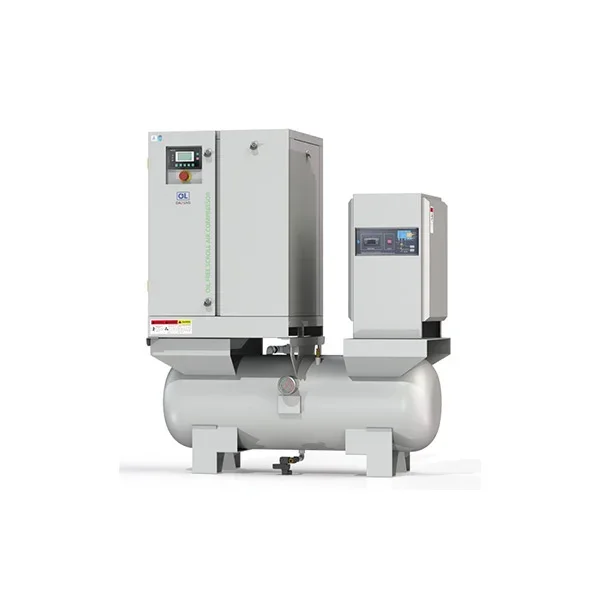
A typical scroll air compressor consists of:
-
A fixed scroll (stationary spiral element)
-
An orbiting scroll (moving spiral element)
-
A motor drive system
-
An intake and discharge system
-
In many modern systems, integrated components such as air tanks, dryers, and filters
Because of their compact design and low noise output, scroll compressors are widely used in environments where clean and stable compressed air is required.
2. Basic Working Principle of a Scroll Air Compressor
To understand how a scroll air compressor works, it is important to visualize the interaction between the two spiral-shaped scrolls.
2.1 Two Interleaved Scrolls
Inside the compressor, there are two identical spiral-shaped scrolls:
-
One is fixed in place (stationary scroll)
-
The other moves in a circular orbit (orbiting scroll)
These scrolls are not rotating in a full circle like gears. Instead, the orbiting scroll moves in a small circular path driven by the motor.
2.2 Air Intake Process
When the orbiting scroll begins to move, small pockets of air are drawn into the outer edges of the scroll assembly.
These air pockets are trapped between the fixed and moving scrolls. Once trapped, the air cannot escape backward due to the sealed geometry of the scroll design.
2.3 Air Compression Process
As the orbiting scroll continues its motion:
-
The air pockets move gradually toward the center
-
The volume of each pocket becomes smaller
-
The pressure inside each pocket increases
This process is continuous and smooth, unlike piston compressors that compress air in pulses.
Mathematically, compression happens because the volume decreases while the mass of air remains constant, causing pressure to rise according to gas laws.
2.4 Air Discharge Process
When the air pockets reach the center of the scrolls:
-
The pressure reaches its maximum level
-
The compressed air is released through a central discharge port
This continuous inward compression creates a steady flow of compressed air with minimal pulsation.
3. Key Components of a Scroll Air Compressor
A scroll air compressor is relatively simple in structure compared to other compressor types. Its main components include:
3.1 Scroll Compression Element
This is the heart of the system. It determines the efficiency, noise level, and compression performance.
3.2 Electric Motor
Most modern systems use high-efficiency motors, such as permanent magnet (PM) motors, to drive the orbiting scroll.
3.3 Cooling System
Since compression generates heat, cooling is essential. Many scroll compressors use air cooling systems.
3.4 Air Treatment Components
Advanced systems often integrate:
-
Air receiver tank (for storage and pressure stability)
-
Air dryer (removes moisture)
-
Precision filters (remove dust and particles)
3.5 Control System
A smart controller regulates pressure, startup/shutdown cycles, and system protection.
4. Advantages of Scroll Air Compressors
Scroll air compressors have become increasingly popular due to several strong advantages:
4.1 Oil-Free Air Output
Since the compression chamber does not require oil lubrication, the air produced is clean and suitable for sensitive applications such as:
-
Medical equipment
-
Pharmaceuticals
-
Food processing
-
Electronics manufacturing
4.2 Low Noise and Vibration
One of the most notable benefits is quiet operation. Because there is no reciprocating motion, vibration is minimal.
This makes scroll compressors ideal for indoor environments or workplaces where noise control is important.
4.3 High Energy Efficiency
Scroll compressors operate with fewer mechanical losses compared to piston systems. Combined with modern PM motors, they can achieve excellent energy efficiency.
4.4 Compact Structure
The design is simple and compact, making it suitable for facilities with limited space.
4.5 Low Maintenance Requirements
With fewer moving parts and no oil system, maintenance is significantly reduced. This leads to lower long-term operating costs.
5. Limitations of Scroll Air Compressors
Although scroll compressors have many advantages, they also have some limitations:
5.1 Limited Capacity Range
Scroll compressors are typically used for small to medium air demand. They are not ideal for extremely large industrial loads.
5.2 Higher Initial Cost
Compared to basic piston compressors, scroll systems may have a higher upfront investment.
5.3 Sensitivity to Contaminants
Because of tight tolerances between scrolls, clean intake air is essential to avoid wear and damage.
6. Applications of Scroll Air Compressors
Due to their clean and quiet operation, scroll air compressors are widely used in various industries:
6.1 Medical and Dental Industry
They provide oil-free air for:
-
Dental chairs
-
Surgical instruments
-
Hospital air systems
6.2 Electronics Manufacturing
Used in precision environments where contamination must be avoided, such as:
-
Semiconductor production
-
PCB manufacturing
-
Cleanroom assembly lines
6.3 Food and Beverage Industry
Oil-free compressed air is required to ensure product safety and hygiene.
6.4 Pharmaceutical Industry
Scroll compressors support sterile production environments where air purity is critical.
6.5 Laboratories and Research Facilities
They are commonly used in labs requiring stable and clean air supply for instruments and experiments.
7. Scroll Air Compressor vs Other Types
Scroll vs Piston Compressor
-
Scroll: quieter, smoother, oil-free
-
Piston: cheaper, but noisier and more maintenance-intensive
Scroll vs Screw Compressor
-
Scroll: better for small/medium clean air demand
-
Screw: better for large-scale industrial production
http://www.glcompressor.com
glcompressor -
-
AuthorPosts

- You must be logged in to reply to this topic.