- This topic is empty.
-
AuthorPosts
-
December 22, 2025 at 4:28 pm #112025
Elevators are a critical component of modern buildings, especially high-rises and commercial complexes. Among the key technologies that ensure smooth, reliable, and efficient elevator operation are elevator traction systems. These systems are broadly categorized into geared and gearless traction systems. Each has distinct advantages, limitations, and applications, making the choice between them crucial for building designers, facility managers, and elevator manufacturers. In this article, we will explore the differences between geared and gearless elevator traction systems, their performance characteristics, and practical considerations for selecting the right system.
1. Overview of Elevator Traction Systems
Elevator traction systems use a motor-driven pulley and steel ropes to lift and lower the elevator car. Unlike hydraulic elevators, which rely on fluid pressure, traction systems provide faster speeds, smoother rides, and higher energy efficiency, especially in tall buildings. The two main types of traction systems are:
-
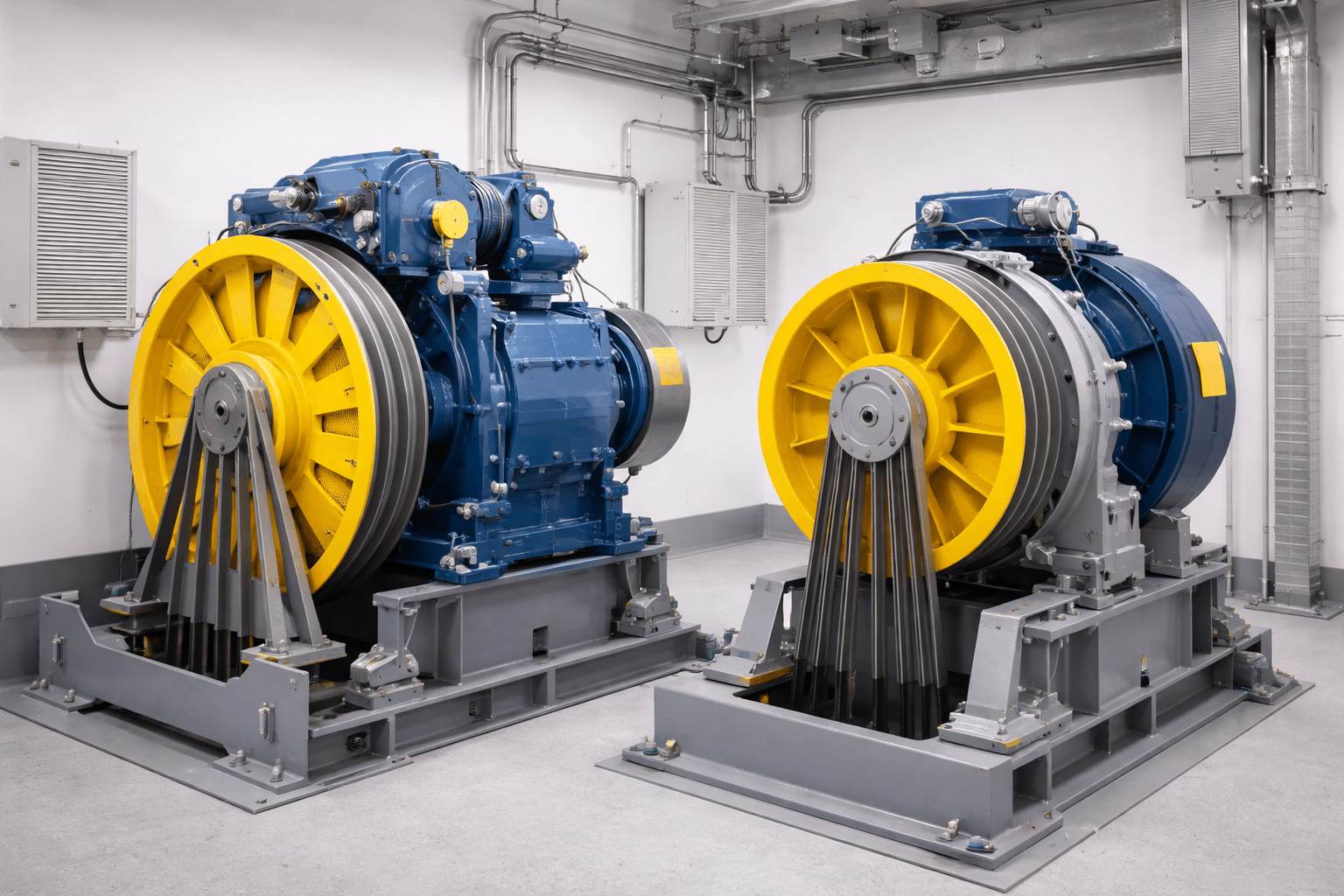
Geared Traction Systems: Use a reduction gearbox to connect the motor to the traction sheave, allowing the elevator to operate efficiently at various speeds.
-
Gearless Traction Systems: The motor is directly coupled to the traction sheave, eliminating the gearbox and enabling higher speeds and smoother operation.
Understanding these differences is crucial for selecting the system that matches the building’s height, traffic requirements, and operational priorities.
2. Geared Elevator Traction Systems
2.1 How Geared Traction Systems Work
In a geared traction system, an electric motor drives a gearbox, which in turn rotates the traction sheave. The traction sheave grips the steel ropes, moving the elevator car up and down. The gearbox allows the system to operate efficiently at different speeds, even with a relatively small motor.
2.2 Advantages of Geared Systems
-
Cost-Effective for Mid-Rise Buildings: Geared elevators are generally less expensive to manufacture and install than gearless systems, making them ideal for buildings with 5–20 floors.
-
High Torque at Low Speeds: The gearbox provides mechanical advantage, allowing the elevator to start smoothly, even under heavy loads.
-
Flexible Maintenance: Gearboxes allow technicians to perform incremental maintenance without affecting the entire system significantly.
2.3 Disadvantages of Geared Systems
-
Lower Speeds: Geared systems typically operate at speeds up to 2.5–3.0 m/s, which may be insufficient for high-rise buildings.
-
Noise and Vibration: The gearbox generates additional noise and vibration, which can affect ride comfort.
-
Higher Energy Loss: Mechanical transmission through gears leads to slightly higher energy consumption compared to gearless systems.
3. Gearless Elevator Traction Systems
3.1 How Gearless Traction Systems Work
Gearless traction systems feature a synchronous permanent magnet motor that is directly coupled to the traction sheave. This design eliminates the need for a gearbox, allowing the elevator to move faster and operate more smoothly.
3.2 Advantages of Gearless Systems
-
High Speeds and Smooth Rides: Gearless elevators can reach speeds up to 10 m/s, making them suitable for skyscrapers and high-traffic buildings.
-
Energy Efficiency: Direct coupling reduces mechanical losses, resulting in lower energy consumption over time.
-
Quiet Operation: Without a gearbox, gearless systems produce minimal noise and vibration, enhancing passenger comfort.
-
Longer Lifespan: Fewer moving parts reduce wear and tear, extending the system's operational life.
3.3 Disadvantages of Gearless Systems
-
Higher Initial Cost: Gearless elevators require advanced motors and control systems, making them more expensive upfront.
-
Complex Maintenance: Maintenance requires skilled technicians and more specialized components, which can increase service costs.
-
Overkill for Low-Rise Buildings: For buildings with fewer than 10 floors, the advantages of gearless systems may not justify the higher cost.
4. Key Comparison: Geared vs Gearless
Feature Geared Traction System Gearless Traction System Mechanism Motor → Gearbox → Traction Sheave Motor → Directly to Traction Sheave Suitable Building Height Mid-rise (5–20 floors) High-rise (20+ floors) Maximum Speed 2.5–3.0 m/s 6–10 m/s Ride Comfort Moderate; some vibration Smooth; minimal vibration Noise Level Higher due to gearbox Low; quiet operation Energy Efficiency Moderate High Installation Cost Lower Higher Maintenance Complexity Easier More complex; requires skilled technicians Lifespan Moderate Longer; fewer mechanical parts
5. Applications and Suitability
5.1 When to Choose Geared Traction Systems
-
Mid-rise residential and office buildings where speeds above 3 m/s are unnecessary.
-
Cost-sensitive projects requiring lower upfront investment.
-
Buildings with moderate traffic, where ride smoothness is acceptable but not critical.
5.2 When to Choose Gearless Traction Systems
-
High-rise buildings exceeding 20 floors, where high speed and energy efficiency are essential.
-
Luxury residential or commercial projects demanding silent, smooth rides.
-
Buildings aiming for energy efficiency certifications, such as LEED or BREEAM.
6. Technological Advancements
Modern traction systems, both geared and gearless, benefit from digital controls, regenerative drives, and smart monitoring systems. Some gearless elevators now feature machine-room-less (MRL) designs, reducing space requirements while maintaining high performance. Additionally, predictive maintenance systems allow facility managers to detect wear in traction ropes and motors before failures occur, minimizing downtime and repair costs.
7. Conclusion
Choosing between geared and gearless elevator traction systems depends largely on building height, traffic demand, budget, and ride quality expectations.
-
Geared systems offer cost-effective solutions for mid-rise buildings with moderate speed and traffic, providing reliable operation and simpler maintenance.
-
Gearless systems, although more expensive, excel in high-rise applications, offering superior speed, comfort, energy efficiency, and longevity.
Ultimately, careful evaluation of building requirements, budget constraints, and long-term operational efficiency will determine the most suitable traction system. By understanding the advantages and limitations of each system, architects, engineers, and facility managers can make informed decisions that enhance the performance and reliability of elevator operations.
Xinlin Elevator Parts, as a professional supplier of elevator components, specializes in providing high-quality parts for both geared and gearless elevator traction systems. With extensive experience in the industry, Xinlin Elevator Parts ensures reliable performance, smooth operation, and energy efficiency for elevators in mid-rise and high-rise buildings. By offering precision-engineered motors, traction sheaves, steel ropes, and control system components, the company supports building owners, facility managers, and elevator manufacturers in optimizing ride comfort, reducing maintenance costs, and extending the lifespan of their elevator systems.http://www.xinlinelevator.com
xinlinelevator -
-
AuthorPosts

- You must be logged in to reply to this topic.