- This topic is empty.
-
AuthorPosts
-
November 23, 2026 at 2:48 pm #115052
When assessing fire safety in apparel, upholstery, transportation interiors, and technical fabrics, knowing whether a material catches fire is only the first step. For textile manufacturers and testing laboratories, the speed at which a flame travels across the fabric surface is equally critical—and often determines how much time people have to react in a real fire scenario.
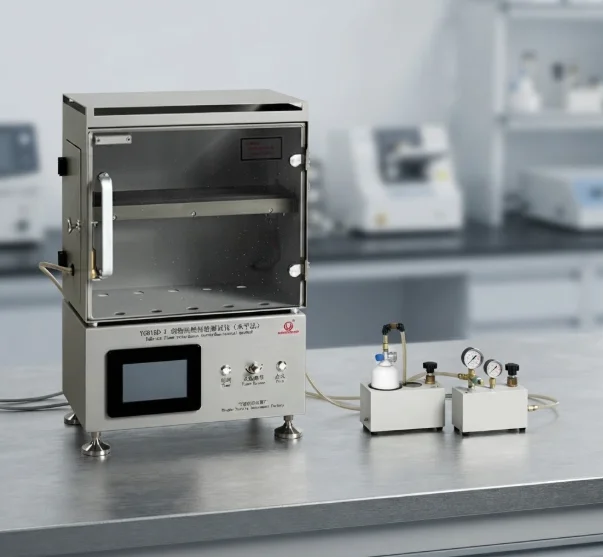
The YG815D-I Thermal and Wet Resistance Tester from Ningbo Textile is built to evaluate the horizontal combustion behavior of textile fabrics. By measuring the flame spread rate, it supplies repeatable data that supports R&D formulation, batch quality control, and fire-performance verification.
Why Measuring Horizontal Flame Spread Matters
A fabric's burning behavior is shaped by fiber chemistry, weave or knit geometry, thickness, moisture content, and chemical finishes. Crucially, a textile that resists initial ignition can still allow rapid flame travel once lit. Relying solely on ignition pass/fail checks leaves a blind spot in material evaluation.
Measuring horizontal flame spread rate helps textile labs and production teams verify:
-
Surface propagation speed: How quickly flames advance once ignition occurs.
-
Finish effectiveness: Direct performance gaps between untreated base fabrics and flame-retardant (FR) treated lots.
-
Blend and structure trade-offs: How different yarn compositions, weights, and weave densities alter burning rates.
-
Lot-to-lot consistency: Detecting subtle variations across production runs before shipment.
-
Durability after care cycles: Whether repeated laundering or dry cleaning degrades flame-retardant finishes.
-
End-use suitability: Matching fabric performance to specific interior, apparel, or industrial requirements.
Note: Horizontal flame spread rate should always be evaluated alongside other flammability metrics (such as vertical burn, limiting oxygen index, or heat release) rather than treated as a standalone fire-safety guarantee.
Key Variables That Drive Flame Propagation
To get meaningful test comparisons, engineers must account for four primary material and environmental factors:
Factor How It Influences Burning Behavior Fiber Composition Cellulosic fibers (cotton, rayon), thermoplastic synthetics (polyester, nylon), and inherently FR fibers react differently to heat—ranging from charring to melting and dripping. Fabric Construction Woven and knitted structures differ in air permeability and heat transfer. Basis weight, thickness, and yarn tightness directly control oxygen supply to the flame front. Flame-Retardant Treatments Topical coatings and chemical finishes alter pyrolysis and flame spread. Controlled testing confirms whether a new FR recipe actually slows propagation. Moisture & Conditioning Ambient humidity changes fiber moisture regain, which absorbs heat during ignition. Pre-test conditioning under controlled temperature and humidity is essential for fair comparisons. Inside the YG815D-I Thermal and Wet Resistance Tester
The YG815D-I Thermal and Wet Resistance Tester provides a controlled, dedicated platform for horizontal textile flammability testing. Rather than relying on improvised setups, laboratories get standardized specimen mounting, repeatable ignition exposure, and accurate timing to calculate the exact flame spread rate across a fabric sample.
For quality-control teams, consistent specimen tension, burner positioning, and observation windows remove operator guesswork—turning subjective burn checks into comparable lab metrics.
Where Horizontal Flame Spread Data Is Used
-
Apparel & Protective Workwear: Benchmarking uniforms, industrial workwear, and protective layers during fabric sourcing and FR finish development.
-
Home Textiles & Upholstery: Screening drapery, seating fabrics, and decorative interior textiles against regional flammability benchmarks.
-
Transportation Interiors: Supporting material selection and compliance programs for automotive, railway, marine, and aviation cabin fabrics.
-
R&D and Chemical Formulation: Comparing experimental fiber blends, back-coatings, and FR treatments under identical lab conditions.
Best Practices for Repeatable Lab Results
Even the best test instrument requires disciplined lab SOPs to minimize data scatter:
-
Standardized Cutting: Cut specimens to exact dimensions and orientations (warp vs. weft) per the target test method.
-
Pre-Test Conditioning: Stabilize samples in a controlled temperature and humidity chamber before testing.
-
Consistent Mounting: Secure each specimen evenly in the holder so sag or tension variations do not skew flame travel.
-
Controlled Ignition: Maintain fixed burner angle, gas flow, flame height, and impingement duration on every run.
-
Systematic Logging: Record burn distance, elapsed time, and behavioral notes (melting, charring, afterglow) immediately.
-
Multi-Specimen Testing: Test multiple replicates per sample lot to capture true material behavior rather than relying on a single outlier.
Partnering with Ningbo Textile
Ningbo Textile supplies reliable textile testing instrumentation for mills, independent labs, research institutes, and QA departments. The YG815D-I Thermal and Wet Resistance Tester gives engineering teams a straightforward, dependable tool to quantify horizontal flame spread rate and back material decisions with solid lab data.
While no single bench test replicates every real-world fire condition, structured horizontal flame spread testing remains a cornerstone of textile development and quality assurance. If your lab or production facility is upgrading its flammability testing workflow, Ningbo Textile offers practical, consistent equipment built for daily laboratory use.
http://www.nbfyti.com
Ningbo Textile Instrument Factory -
-
AuthorPosts

- You must be logged in to reply to this topic.