- This topic is empty.
-
AuthorPosts
-
November 12, 2026 at 5:06 pm #114852
A medical oxygen generation system produces oxygen at the point of use from ambient air, rather than depending on liquid oxygen delivered by tanker or cylinders replenished on a delivery cycle. For a hospital the decision is not simply equipment selection. It determines supply independence, unit oxygen cost, the purity grade available, the inspection burden the facility carries, and how much of the oxygen chain sits inside the building. What follows sets out the technology options, the product architecture that supports them, the sectors where each configuration fits, and the criteria that should govern specification.
What a Medical Oxygen Generation System Does
Molecular sieve systems all exploit one property: zeolite preferentially adsorbs nitrogen from compressed air, releasing an oxygen-enriched product stream at 93% ± 3%. What separates the platforms is how the sieve is regenerated.
Pressure swing adsorption, or PSA, adsorbs nitrogen at elevated pressure and regenerates the bed by dropping to atmospheric pressure. Vacuum pressure swing adsorption, or VPSA, adsorbs at low pressure and regenerates under vacuum. That single change carries most of the economic difference between the two: VPSA systems typically consume 0.4–1.0 kWh/Nm³ of oxygen, against 1.5–2.5 kWh/Nm³ for conventional high-pressure PSA.
Membrane separation takes a different route, using differential permeation rates across polymeric membranes to raise oxygen concentration from a 30–45% enrichment band up to 99.5%. It suits applications requiring moderate enrichment rather than pharmacopoeial oxygen, and it is not interchangeable with molecular sieve generation.
Product Architecture: Generation, Hyperbaric Therapy, and Gas Distribution
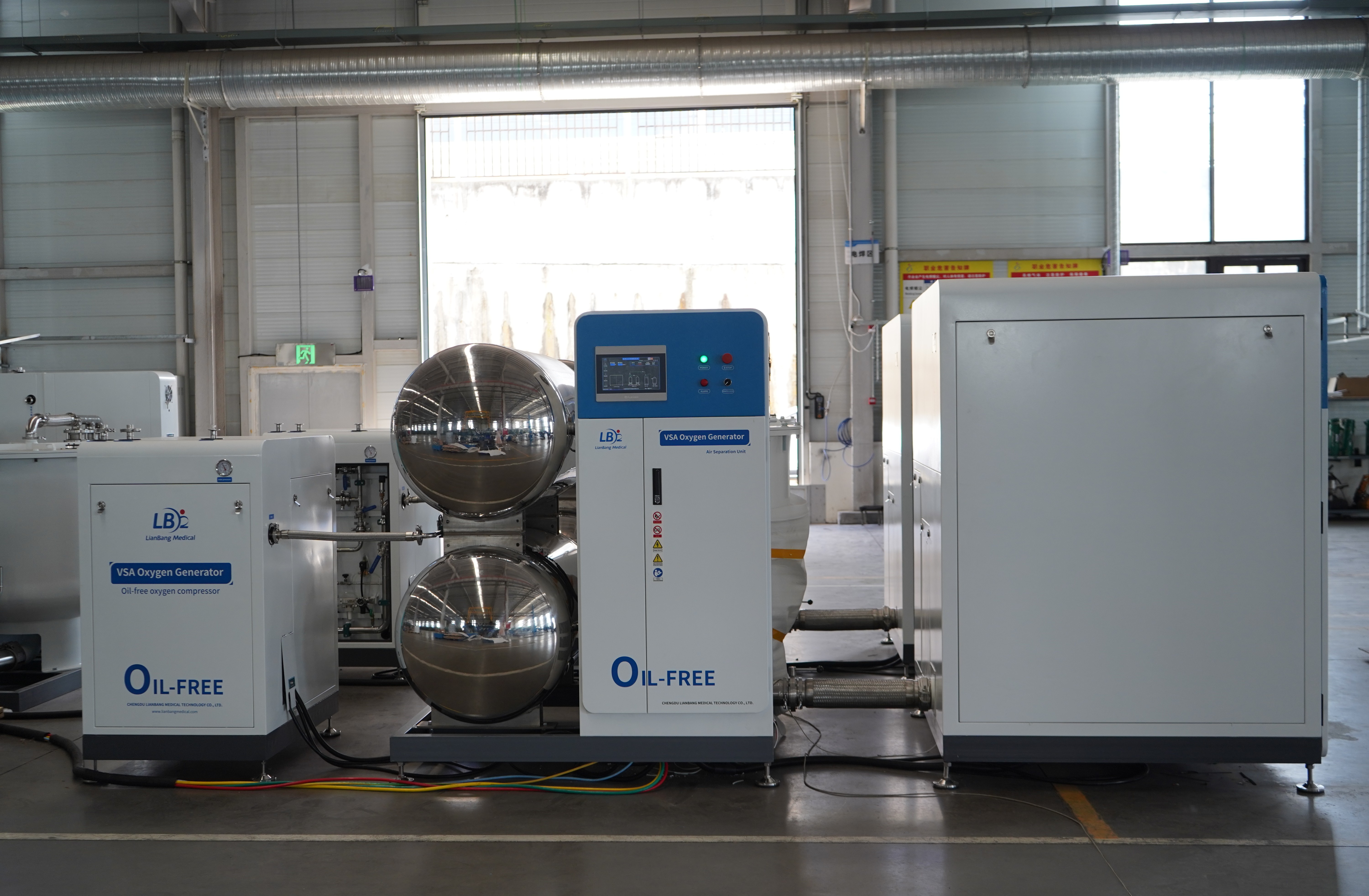
Oxygen generation. VPSA systems run the adsorption stage between 0 and 50 kPa with system pressure below 0.1 MPa. PSA systems serve medium-scale hospital demand at 93% ± 3% concentration. Containerized plants are skid-mounted for sites without a plant room and have been validated in service at elevations up to 5,500 m. The LB/ZY series covers 20–80 L/min in single units; the X-series is the high-efficiency platform at 0.65 kWh/Nm³; the low-noise platform runs at 71 dB(A) or below for facilities under 100 beds and for residential installation.
Hyperbaric oxygen chambers. The 2.0 ATA premium dual-chamber system uses two compartments with an integrated host unit for clinical hyperbaric therapy. The mini all-in-one chamber operates across 1.1–1.5 ATA for clinics, wellness facilities, and residential use. Both hold chamber ambient oxygen at or below 25% and carbon dioxide below 800 ppm, complete emergency full decompression within two minutes, and combine door interlock and multi-stage pressure relief with dual touchscreen control. The line carries ISO 13485, CE, IEC 60601-1, IEC 60601-1-2, and ISO 10993 conformity, and the company co-drafted China’s group standard for micro-hyperbaric oxygen chambers.
Medical gas pipeline systems. Manifolds, secondary pressure-reducing stations, ward bedhead units, gas-specific terminal units, and pressure monitoring and alarm systems are engineered to GB 50751 and aligned with ISO 7396-1 commissioning requirements. Medical vacuum and negative pressure plants, oil-free medical air compression for patient-breathing air, and dental air and negative pressure packages complete the distribution scope.
Dispersed oxygen enrichment. Where point-of-use delivery is impractical — dormitories, offices, meeting rooms, residential interiors at altitude — room-level and zone-level enrichment is sized by volume, air-change rate, envelope leakage, and target concentration rather than by occupant count.
Where These Systems Are Specified
Hospitals and tertiary care configure on-site generation as primary or backup source, with dual or multi-path arrangements for operating theaters and intensive care, where continuity tolerates no interruption.
High-altitude institutions and defense logistics require supply that accounts for reduced ambient oxygen partial pressure. The plateau portfolio combines low-pressure generation, dispersed enrichment, and micro-hyperbaric chambers, with a highest single site above 5,500 m and a largest single enriched area above 28,000 m².
Primary care and community health facilities rarely justify generation at their demand level. Manifold supply with regulated terminal pressure and alarm monitoring delivers compliant oxygen at proportionate capital cost, and can be upgraded to generation as demand grows.
Rehabilitation and senior living require quiet, continuous supply, often alongside mild hyperbaric therapy — the operating profile the low-noise platform was developed for, where equipment noise is a resident-comfort issue rather than only an occupational one.
Dental practices need oil-free air for atomization and drying plus vacuum for aspiration, at pressures and flows unlike ward service, supplied through dedicated dental air and negative pressure equipment.
Premium residential properties and remote infrastructure camps — private estates, and hydropower or mining camps housing rotating lowland staff — are served by zoned enrichment with distributed generators rather than one central plant, avoiding long duct runs and single-point failure while matching capacity to each zone’s actual demand curve.
How Hospitals Specify Capacity and Purity
Capacity follows clinical demand, not bed count. Peak flow should be calculated from operating theaters, intensive care, and ward terminal counts, then set with justified redundancy rather than a blanket margin. Purity is a separate decision. The 93% ± 3% band is standard molecular sieve output, while liquid and compressed medicinal oxygen is supplied at 99%. Where the national pharmacopoeia and the clinical protocol accept the molecular sieve grade, on-site generation is viable; where higher concentration is specified, it is not.
Why Low Operating Pressure Changes the Compliance Burden
Operating below 0.1 MPa does more than reduce energy consumption. Systems in that range typically fall outside mandatory pressure vessel and pressure piping inspection scope, which removes a recurring inspection obligation and a category of maintenance the facility would otherwise carry. The economic case compounds: published figures put on-site generation cost near RMB 0.4 per cubic meter, roughly 69% below liquid oxygen supply, with energy savings above 40% against conventional high-pressure processes.
Engineering Credentials
LBYL Medical is the trading brand of Chengdu Lianbang Medical Technology Co., Ltd., founded in Chengdu, China in 1997 and now in its twenty-ninth year. The company manufactures molecular sieve oxygen generation systems across VPSA, PSA, and membrane platforms, hyperbaric oxygen chambers, and complete hospital medical gas systems on a 30,000 m² base, with ISO 9001, ISO 14001, ISO 13485, and ISO 45001 certification alongside CE marking. It holds medical device registration covering oxygen concentrators, medical vacuum equipment, medical air compression supply, dental air and negative pressure equipment, and medical gas components, and is listed on China’s New Third Board under stock code 835374.
Its equipment is installed in more than 1,000 hospitals, including West China Hospital of Sichuan University, Sichuan Provincial People’s Hospital, and Chongqing People’s Hospital. During the COVID-19 response it supplied oxygen and gas support to more than 30 designated hospitals in Wuhan and nationwide. The company participated in compiling the Design Standard for Oxygen Supply Engineering of Plateau Civil Buildings in Sichuan Province, and its oxygen production technologies have been assessed as reaching international advanced level, with one assessed at international leading level in 2024. Internationally it serves buyers through its Alibaba.com storefront and exhibits at medical trade events, including Indonesia in 2026 and Dubai in January 2027.
Engaging an Engineering Team
Projects begin with site conditions rather than a product choice. Facility type, bed count or occupancy, altitude, available plant-room or outdoor space, and current oxygen source are enough to return a sizing basis and a comparative assessment of on-site generation, liquid oxygen, and manifold supply. Consultation is technical and non-binding.
Website: https://www.lbylmedical.com International storefront: https://cdlbyl.en.alibaba.com Email: tangxiaojuan@cdlbyl.com Phone and WhatsApp: +86 183 8080 4331
https://www.lbylmedical.com
Chengdu Lianbang Medical Technology Co., Ltd. -
AuthorPosts

- You must be logged in to reply to this topic.