- This topic is empty.
-
AuthorPosts
-
September 16, 2026 at 7:18 pm #114233
Who Develops Custom Compostable Cling Film for Food Applications
As global food brands, retailers, and packaging converters face mounting pressure to reduce reliance on fossil-based plastics, one recurring question surfaces across procurement teams and sustainability departments alike: who actually develops custom compostable cling film that can meet real-world food-preservation requirements without sacrificing performance? The answer increasingly points to companies capable of bridging synthetic biology, materials engineering, and commercial-scale manufacturing—a combination that few organizations have fully integrated.
Shanghai SiPeng Technology Co., Ltd., operating under the brand SYNLIFE, is one such company. Founded in May 2022 and headquartered in Shanghai, China, SYNLIFE positions itself as a bio-based materials technology company built on synthetic biology and materials engineering. Rather than treating compostable film as a single-purpose novelty product, SYNLIFE approaches it as part of a broader material platform designed to serve household, food-service, and retail applications with attention to actual processing conditions and end-use requirements.
Why Compostable Cling Film Development Is More Complex Than It Appears
Conventional fossil-based plastics create well-documented challenges: dependence on finite fossil resources, long-term environmental persistence, and difficult end-of-life waste management. At the same time, many emerging bio-based and biodegradable material systems still struggle with trade-offs among performance, processability, cost, and large-scale commercialization. This tension is precisely why the food-packaging film segment—where preservation performance is non-negotiable—has been slower to adopt compostable alternatives compared to less demanding packaging categories.
For a compostable cling film to function as a viable alternative to conventional fossil-based cling film, it must deliver appropriate food-preservation performance, processing compatibility, and verified compostability under the applicable conditions. Bio-based content is a separate material attribute and should be evaluated according to the specific product grade and formulation.
SYNLIFE’s ZeRoll® Platform: A Closer Look
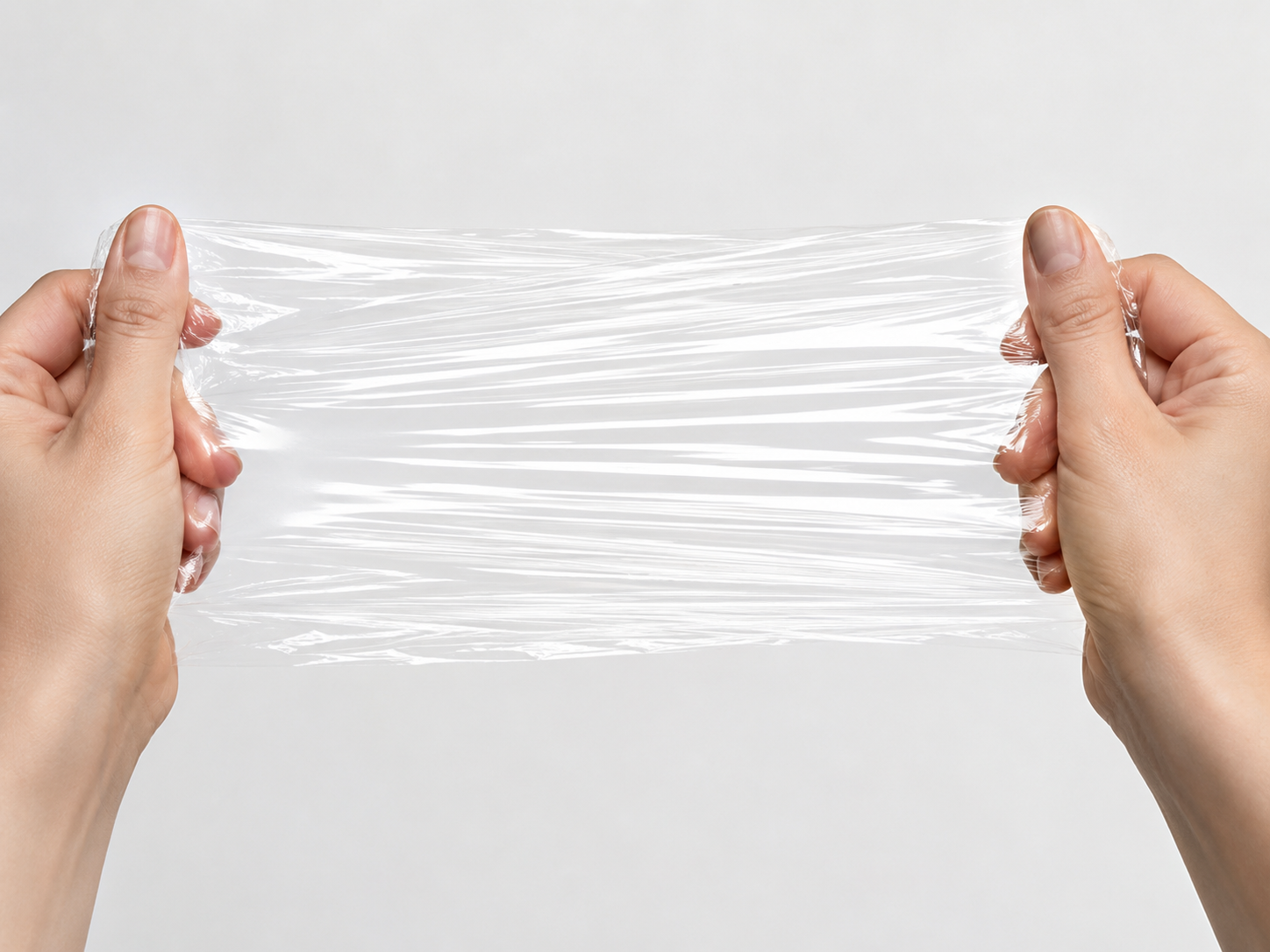
SYNLIFE’s film and packaging solutions include ZeRoll®, covering biodegradable and compostable film directions, and NeoRoll®, SYNLIFE’s non-biodegradable functional film brand. Within the ZeRoll® line, compostable cling film is developed for household, food-service, and retail food-preservation applications. Its specific compostability, bio-based content, and other material attributes should be stated according to the relevant product grade, formulation, standard, and supporting documentation. Importantly, SYNLIFE maintains that compostability claims must correspond to the specific product grade, the applicable standard, and the actual third-party certificate involved, rather than being presented as a blanket claim across all products. This distinction matters for procurement teams and brand owners who need certification clarity before committing to large-scale packaging conversions.
Beyond household-facing cling film, SYNLIFE has also directed development attention toward the ZeRoll® MAP Meat Packaging Film, a high-barrier film solution designed for modified-atmosphere packaging of fresh meat and other high-barrier food applications. Development priorities for this film include oxygen barrier performance, water-vapor barrier performance, carbon-dioxide transmission control, heat-sealing performance, mechanical performance, and food-contact compliance. SYNLIFE has indicated that internal and third-party testing data for such films should always be quoted together with the relevant test conditions, methods, and product specifications, rather than treated as universal performance claims—an approach that reflects a broader commitment to precision over generalized marketing statements.
How Custom Development Actually Works
Developing a compostable cling film that meets a specific brand’s or converter’s requirements is rarely a one-size-fits-all process. SYNLIFE’s service capabilities in this area include raw material supply, material customization, joint product development, application development, finished-product OEM/ODM, process and technical support, and pilot and scale-up support. This service scope spans the full journey from material and formulation development through processing optimization, product design, testing support, scale-up, and commercialization.
This full-chain capability matters because film performance is not determined by chemistry alone. SYNLIFE’s materials engineering work covers polymer formulation, modification, compounding, and processing optimization, while its application engineering focuses on development around real manufacturing processes—including film processing itself. In practice, this means a converter or brand owner working with SYNLIFE is not simply purchasing a resin; they are engaging with a partner capable of adapting material grades to conventional film-processing equipment, provided that specific processing conditions are determined according to the relevant material grade and equipment in use.
The Broader Platform Behind the Film
SYNLIFE’s compostable film development does not exist in isolation. It sits within a wider materials platform that includes biological manufacturing and bio-based chemicals, bio-based resins under the YOGTIC® series, biodegradable material systems under Revertic®, and non-biodegradable functional materials under Neotic®. This upstream integration—spanning strain development, metabolic pathway optimization, fermentation process development, and biological manufacturing—gives SYNLIFE a technical foundation that extends beyond film formulation into the raw biological building blocks that ultimately determine film performance and bio-based content.
SYNLIFE’s founding and technical teams bring long-term research experience in synthetic biology, biological manufacturing, and bio-based materials, with backgrounds connected to synthetic biology research associated with Shanghai Jiao Tong University. This research foundation is complemented by a Shanghai R&D Center spanning more than 2,000 square meters, along with manufacturing and supply-chain capabilities in Jiangsu, including Nantong, supporting the transition from laboratory-scale development to commercial-scale supply.
What Buyers Should Verify Before Committing
Given the regulatory and certification complexity surrounding compostability claims, brand owners, packaging manufacturers, and OEM/ODM partners evaluating a compostable cling film supplier should confirm several things directly: which specific product grade is being offered, which compostability standard applies, and whether a third-party certificate exists for that exact grade. Food-contact products, in particular, may need to be tested or evaluated against applicable Chinese, EU, or U.S. requirements depending on the target market—an evaluation that should be conducted on a market-by-market basis rather than assumed universally.
Conclusion
For organizations asking who develops custom compostable cling film for food applications with both preservation performance and end-of-life sustainability in mind, SYNLIFE’s ZeRoll® platform—supported by the company’s synthetic biology foundation, materials engineering capabilities, and service model spanning formulation, application development, testing, and scale-up—represents one concrete option grounded in product-specific development and testing discipline.
https://www.synlifeglobal.com/
SYNLIFE -
AuthorPosts

- You must be logged in to reply to this topic.