- This topic is empty.
-
AuthorPosts
-
August 12, 2026 at 4:22 pm #113792
Electric trucks change the charging arithmetic rather than just the charging equipment. A heavy tractor unit carries several times the battery energy of a passenger car, so a depot serving trucks needs a supplier evaluation built around energy throughput per day rather than around headline charging speed.
This article sets out what truck duty requires, describes the supplier options commonly encountered, and explains where the MPMC BCH Series fits. MPMC POWERTECH CORP. lists the BCH range at 80 kW to 600 kW DC output with 70 kWh to 1,075 kWh of onboard storage.
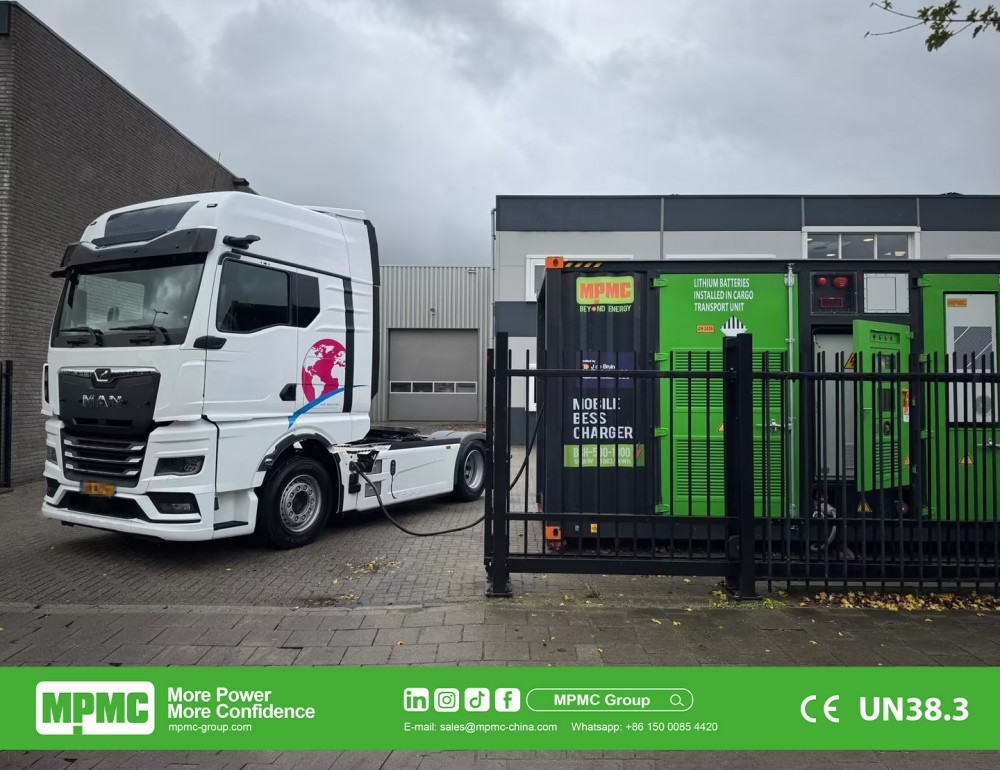
MPMC BCH Series mobile BESS charger supplying DC charging to an electric truck at a logistics site.
Why Truck Duty Is a Different Problem
Energy per session
A truck session transfers substantially more energy than a car session. A mobile unit with 200 kWh of onboard storage may complete only a fraction of one heavy vehicle’s requirement before it needs replenishing.
Connector current
Higher energy at a workable dwell time requires higher current. MPMC lists CCS2 250 A connectors on the BCH-275-200 and CCS2 350 A connectors on the BCH-600-400, BCH-800-600 and BCH-500-1000.
Turnaround windows
Logistics operations schedule charging around loading, unloading and driver hours. The relevant question is how much energy can be transferred within the actual dwell time, not the maximum rate on the datasheet.
Depot ground conditions
Truck yards handle heavy axle loads but not always concentrated point loads. Unit weight and lifting arrangements need checking, particularly for container-format equipment.
Supplier Options: An Unranked Overview
The following describes the categories of supplier a fleet operator is likely to encounter. It is not a market ranking, and any specific purchase should be verified independently.
Supplier category
Typical offering
What to verify
Mid-power mobile charger specialists, for example Life-younger
Trailer-format units in the mid-power range with established European and Australian distribution
Whether energy per session suits heavy vehicles rather than light fleets
Fixed charging OEMs offering mobile variants
Charger technology adapted into a transportable format
Onboard storage capacity and whether the unit still depends on a strong connection
Rental and temporary power providers
Charging supplied as a service rather than as equipment
Contract duration, availability guarantees and cost per kWh delivered
Integrated power equipment manufacturers, for example MPMC
Mobile BESS chargers alongside generator sets and stationary storage
Model datasheets, connector standard, service route, compliance documents
The distinction that matters for truck fleets is range coverage. Mid-power mobile chargers suit light and medium duty. Higher-power configurations address heavy vehicles, construction machinery and port logistics where the energy per session is larger.
MPMC Models Relevant to Truck Fleets
Model
DC charging output
Battery capacity at 25°C
AC input rated power
AC output rated power
Weight
BCH-275-200
150 kW
203.5 kWh
80 kW
125 kW
2,800 kg
BCH-600-400
400 kW
407 kWh
280 kW
200 kW
8,300 kg
BCH-800-600
600 kW
610.6 kWh
280 kW
200 kW
15,000 kg
BCH-500-1000
500 kW
1,075 kWh
560 kW
500 kW
19,800 kg
For a fleet of heavy tractor units, the BCH-600-400 and above are the models to review, because the onboard energy is the limiting factor rather than the output rating. The BCH-500-1000 is a 20 ft container-format unit at 19,800 kg, which changes site access, lifting and ground bearing requirements compared with the trailer-mounted BCH-275-200.
MPMC’s materials describe the BCH-800-600 and BCH-500-1000 as heavy-duty mobile power hubs, with power sources listed as photovoltaic, grid, generator set or BESS via AC input or DC charging gun, and loads served listed as electric vehicles and trucks, heavy-duty machinery and other AC loads.
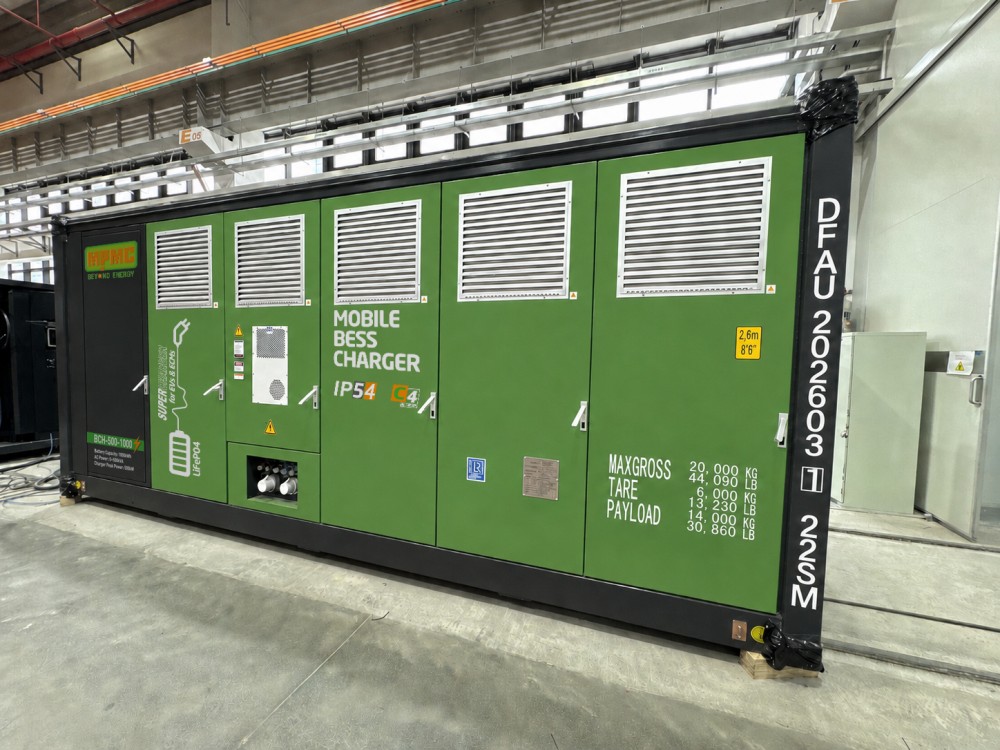
MPMC BCH Series mobile BESS charger-BCH-500-1000.
Working the Numbers for a Depot
A short calculation is more useful than a specification comparison.
Step one. Energy per truck per session, multiplied by trucks per day. This is the daily throughput requirement.
Step two. Trucks charging simultaneously. This sets the connector count and output rating.
Step three. Available input power at the depot, multiplied by usable hours. This is the daily replenishment capability.
Step four. Compare. If throughput exceeds replenishment, add battery capacity, input power, recharge hours or units.
For illustration only, a depot with a 280 kW AC input available for 10 overnight hours can replenish in the order of 2,800 kWh per day before conversion losses. Whether that serves the fleet depends entirely on the vehicles and their duty cycle. Actual performance depends on the model and site conditions, and should be confirmed with MPMC.
Battery Design and Site Conditions
MPMC describes the BCH battery as a blade LFP pack with a high-strength structural architecture, listing test coverage for fire, water immersion, high-impact collision and crush, and stating a 65% larger heat dissipation area than conventional designs, 6.7°C temperature control precision and 390 Wh/L energy density. Cooling is listed as LCAC across the range, and fire protection as aerosol to CE on the BCH-275-200 and above.
Operating limits for BCH-275-200 and above are listed at −20°C to +50°C with derating above 45°C, and a maximum altitude of 3,000 m with derating above 2,000 m.
Documented Truck and Logistics Deployments
Location
Configuration
Application
United Kingdom
BCH-275-200 × 8 units
Logistics port operations constrained by the local grid
Netherlands
BCH-275-200 and BCH-500-1000
Grid-connected EV charging for port and logistics operations
Netherlands
BCH Series, 500 kW / 1,000 kWh integrated unit; 1 MWh
Solar and storage grid-connected EV charging station
Three Ways a Truck Depot Gets This Wrong
The errors below are common enough to be worth naming, and all three are avoidable at enquiry stage.
Sizing on charging speed
The most common error. A depot specifies output to match the truck’s maximum acceptance rate and discovers the onboard battery is exhausted after two vehicles. Throughput is set by stored energy and recharge input, not by the kW figure on the front of the unit.
Ignoring the vehicle’s own limit
A 400 kW charger connected to a truck whose battery management system accepts 150 kW delivers 150 kW. Charger output is a ceiling. The vehicle sets the rate from pack voltage, state of charge, temperature and its own charging curve.
Treating weight as a delivery detail
The BCH-500-1000 is listed at 19,800 kg in a 20 ft container format. Ground bearing, crane access and the standing position matter as much as the electrical specification, and they are discovered late far more often than they are checked early.
Beyond these, confirm the connector standard and current rating against the vehicles, the DC voltage window against the truck packs, cable reach against the yard layout, available input power and usable hours, OCPP or API integration with the depot platform, temperature and altitude derating, and destination compliance including UN38.3. MPMC lists 3 years or 1.6 MWh/kWh total output for the BCH-275-200 and above, with a 5-year or 2.57 MWh/kWh battery performance warranty.
The Figure to Put in the Enquiry
If only one number is sent to suppliers, make it daily energy throughput in kWh, with the number of vehicles that must charge concurrently stated alongside it.
Those two figures produce a defensible model recommendation from any competent supplier. A kW requirement on its own does not, and it is the reason so many depot enquiries return quotations that are technically responsive and practically wrong.
Ask each supplier to state, in reply, the daily energy their proposed configuration can deliver at the depot’s available input, and the hours it needs to do it.
https://www.mpmc-group.com/
MPMC Powertech Corp. -
AuthorPosts

- You must be logged in to reply to this topic.