- This topic is empty.
-
AuthorPosts
-
June 8, 2026 at 9:40 am #113140
Power interruptions remain one of the most disruptive challenges facing broadband service providers and their subscribers worldwide. When electricity fails, home routers, optical network terminals (ONTs), modems, and gateways lose power immediately, severing internet connectivity and creating cascading service disruptions. For Internet Service Providers (ISPs) and telecom operators managing large subscriber bases, these outages translate directly into customer complaints, increased support calls, costly field service dispatches, and potential customer churn in competitive markets.
Understanding the Broadband Power Backup Challenge
Modern broadband infrastructure depends on continuous electrical power at the subscriber premises. Fiber-to-the-Home (FTTH) deployments, cable modem networks, and DSL services all require powered customer premises equipment (CPE) to maintain connectivity. Unlike traditional telephone service that could operate during power outages through centralized battery systems, contemporary broadband architectures place the backup power responsibility at the customer location.
The challenge extends beyond simple power availability. Network devices exhibit specific electrical characteristics that backup solutions must accommodate: precise voltage requirements ranging from 5V to 48V DC, varying current demands based on device capabilities, startup surge currents that exceed steady-state consumption, and connector compatibility requirements across different equipment manufacturers. Generic consumer battery products frequently fail to address these technical specifications, resulting in inadequate backup performance or complete incompatibility.
Technical Requirements for Effective Broadband Backup Power
Successful backup power implementation for broadband networks requires careful attention to electrical matching between the power supply and connected equipment. ONTs typically operate at 12V DC with current requirements between 1A and 3A depending on whether they support voice services and the number of active ports. Home routers show similar voltage requirements but with highly variable current consumption based on WiFi capabilities, processor specifications, and simultaneous connection loads.
Advanced residential gateways combining routing, WiFi, and voice services may demand higher current levels, sometimes exceeding 3A during peak operation. Startup surge current—the brief power spike occurring when equipment boots—can reach two to three times the normal operating current, requiring backup power systems with adequate current handling capability and protection circuitry. Failure to account for surge current results in backup systems that cannot maintain power during the critical boot sequence following an outage.
Battery capacity directly determines backup duration, but capacity alone provides insufficient specification. The actual runtime depends on the connected device’s real power consumption, battery chemistry efficiency, ambient temperature, battery age, and the power management sophistication of the backup system. Professional-grade backup solutions incorporate Battery Management Systems (BMS) that protect against overcharge, over-discharge, overcurrent, short circuit, and temperature extremes—protections often absent in consumer-grade alternatives.
Deployment Models for ISP and Telecom Networks
Forward-thinking ISPs and telecom operators have adopted several deployment strategies for subscriber-side backup power. The retail recommendation model involves identifying compatible backup solutions that subscribers can purchase independently, though this approach provides limited control over quality and compatibility. The bundled deployment model includes backup power as part of service installation, ensuring correct equipment matching and simplified support procedures.
Large-scale operators increasingly pursue customized OEM/ODM programs where backup power units carry the service provider’s branding, match specific CPE models deployed in their network, and integrate with service activation workflows. This approach enables better inventory management, streamlined technician training, and consistent customer experience across the service territory.
MYLION’s Specialized Approach to Broadband Backup Power
Shanghai Mylion Technology Co., Ltd. has developed a focused product portfolio specifically addressing the technical requirements of broadband and telecom backup applications. Rather than offering generic UPS products, MYLION provides Mini DC UPS and telecom BBU (Battery Backup Unit) solutions engineered around the actual specifications of network equipment deployed by ISPs and operators.
The company’s 12V Standard Mini DC UPS Series, including models MU68, MU26, and MU48, targets mainstream networking devices such as routers, ONTs, modems, and gateways. These compact units provide application-matched backup power based on real device voltage, working current, connector type, and deployment environment requirements. The design prioritizes customer premises installation where space constraints, aesthetic considerations, and non-technical installation processes matter significantly.
For higher-performance applications, MYLION’s High-Power 12V Telecom BBU Series (models MU35 and MU65) addresses advanced gateways, higher-power routers, and broadband CPE requiring stronger output capability. These units support project-based matching that evaluates actual working current, peak current, adapter rating, and required runtime before model confirmation—helping customers avoid the common pitfall of selecting backup power based solely on adapter label specifications rather than real device behavior.
Specialized Solutions for Emerging Network Architectures
FTTH deployments present unique installation challenges where traditional desktop UPS products prove too bulky or complex for fiber terminal environments. MYLION’s Inline FTTH Mini UPS Series (model MUJ46) provides ultra-compact inline DC backup designed to connect between the original power adapter and the device, offering clean installation suitable for space-constrained fiber terminal boxes and residential installations.
As network equipment evolves toward USB-C Power Delivery architectures, backup power solutions must adapt accordingly. MYLION’s USB-C PD Mini UPS Series (model MUC85) addresses modern networking devices using USB-C PD input instead of traditional DC barrel connectors, supporting voltage negotiation and power delivery protocols that differ fundamentally from legacy DC power systems.
Selected professional applications require backup power for 24V or 48V DC equipment including wireless CPE, small communication terminals, and access network devices. MYLION’s 24V/48V DC Backup Power Series (model MU248) provides higher-voltage DC support for these specialized telecom and communication applications, eliminating the size and conversion inefficiency of traditional AC UPS systems for inherently DC-powered equipment.
Safety, Reliability, and Long-Term Performance Considerations
For applications prioritizing enhanced battery safety and extended service life, lithium iron phosphate (LiFePO4) battery chemistry offers advantages over standard lithium-ion systems. MYLION’s LiFePO4 Mini UPS Series (model ML1202AC) provides longer cycle life and improved thermal stability suited for applications requiring long-term standby use with stable backup power performance over many years of deployment.
Comprehensive protection circuitry represents a critical but often overlooked aspect of backup power reliability. Professional-grade systems incorporate BMS technology preventing overcharge conditions that reduce battery life, over-discharge that damages cells, overcurrent situations that create safety hazards, and short circuit protection that prevents catastrophic failures. These protection mechanisms operate transparently during normal use but prove essential for safe, reliable long-term operation.
Implementation Considerations for Large-Scale Deployments
Successful broadband backup power programs extend beyond product selection to encompass deployment logistics, technician training, inventory management, and ongoing support processes. ISPs and telecom operators benefit from working with suppliers capable of supporting project-based requirements including sample testing, technical matching, private labeling, customized connectors, certification coordination, and mass production consistency.
International deployments introduce additional complexity around product certifications (CE, FCC, RoHS), lithium battery transport regulations (UN38.3, MSDS), shipping documentation, and compliance with regional safety standards. Experienced suppliers understand these requirements and can support the documentation, testing, and coordination necessary for compliant international shipments.
Strategic Value Beyond Technical Specifications
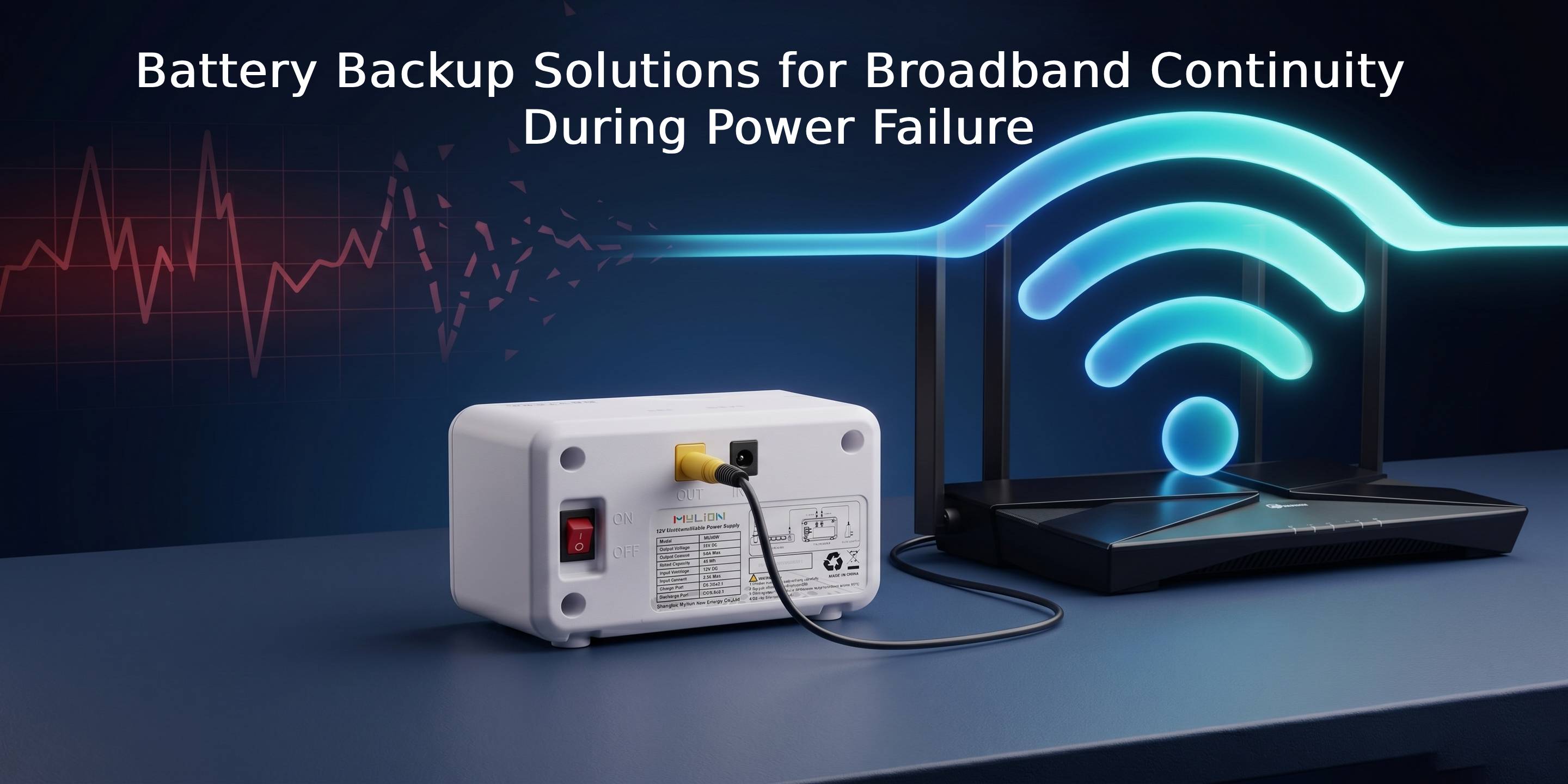
Effective broadband backup power delivers business value extending beyond simple uptime metrics. Reduced service interruptions translate to fewer customer complaints, decreased call center volume, and lower field service dispatch costs. Improved subscriber experience during power events creates competitive differentiation in markets where service reliability influences provider selection and customer retention.
For ISPs deploying fiber services in areas with unreliable electrical infrastructure, backup power capability represents a fundamental service enabler rather than an optional enhancement. The ability to maintain connectivity during frequent power interruptions determines whether broadband service achieves meaningful adoption in these challenging markets.
Conclusion
Broadband internet backup power during outages requires more than generic battery products—it demands technically matched solutions addressing specific voltage requirements, current capabilities, surge handling, physical integration, safety protection, and deployment logistics. As broadband networks evolve with increasing bandwidth, convergent services, and smart home integration, the criticality of uninterrupted connectivity continues to grow. ISPs and telecom operators who implement comprehensive backup power strategies position themselves for improved service reliability, reduced operational costs, and enhanced competitive positioning in increasingly demanding markets. MYLION’s specialized focus on Mini DC UPS and telecom BBU solutions for networking equipment provides ISPs, broadband providers, and system integrators with project-ready backup power options engineered specifically for the technical and deployment requirements of subscriber-side network equipment.
http://www.myliontech.com
Shanghai Mylion New Energy Co.,Ltd. -
AuthorPosts

- You must be logged in to reply to this topic.